

🌟 Introduction: The Evolution From Large AI Models to Small AI Models
Artificial Intelligence has experienced a major transformation with the rise of Large Language Models (LLMs). These powerful AI systems can generate text, answer questions, write code, analyze information, and support complex tasks.
However, large AI models often require massive computing power, expensive infrastructure, and continuous internet connectivity. This has created demand for a new generation of AI technology: Small Language Models (SLMs).
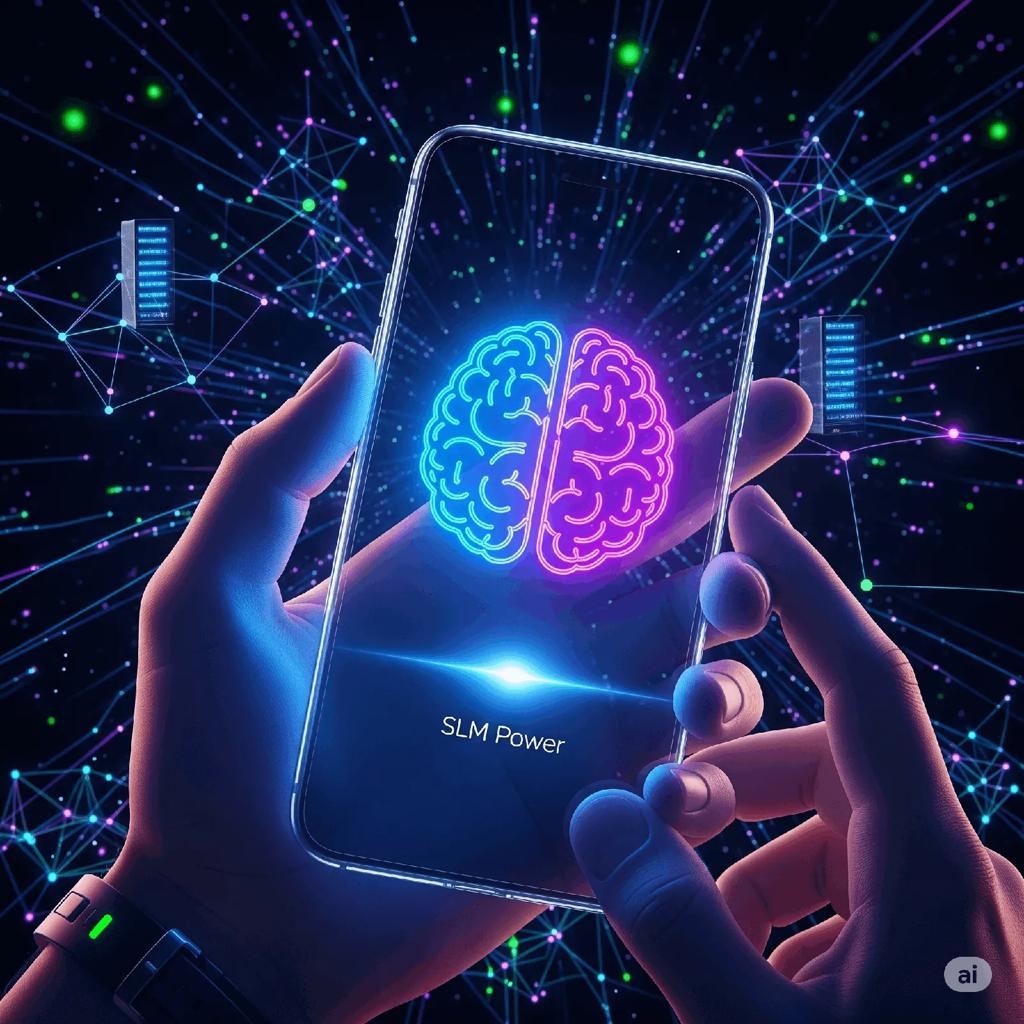
Small Language Models are lightweight AI systems designed to deliver intelligent capabilities with fewer resources. They are becoming an important step toward bringing AI directly to smartphones, personal devices, businesses, and private applications.
SLMs focus on making AI:
📱 Faster
🔒 More private
⚡ More efficient
🌍 More accessible
🤖 1. What Are Small Language Models (SLMs)?
Small Language Models are AI models with fewer parameters compared to Large Language Models.
While LLMs may contain billions or even trillions of parameters, SLMs are designed with a smaller architecture that allows them to run efficiently on limited hardware.
Despite their smaller size, SLMs can perform many useful tasks, including:
- Text generation ✍️
- Summarization 📄
- Translation 🌐
- Voice assistance 🎙️
- Data analysis 📊
- Personal AI support 🤖
The goal of SLMs is not simply to create smaller AI but to create AI that is practical, efficient, and available everywhere.
⚡ 2. Why Small Language Models Are Becoming Important
Large AI models have impressive capabilities, but they also have limitations.
High Computing Requirements
Large AI systems require powerful servers and expensive hardware. This increases operational costs and energy consumption.
SLMs can operate with fewer resources, making AI more affordable for startups, businesses, and individuals.
Faster Performance
Because SLMs are smaller, they can process information faster, especially on local devices such as smartphones and laptops.
Better Privacy
One of the biggest advantages of SLMs is that they can run directly on devices.
This means sensitive information can stay private without being sent to external servers.
Examples include:
🔐 Personal AI assistants
📱 Private messaging tools
🏥 Healthcare applications
💼 Business productivity software
📱 3. SLMs on Smartphones: AI Everywhere
The future of mobile technology is becoming increasingly AI-powered.
Smartphones are gaining advanced processors capable of running lightweight AI models directly on the device.
SLMs can improve smartphone experiences through:
Intelligent Personal Assistants
AI assistants can understand user preferences, manage tasks, summarize information, and provide personalized recommendations.
Offline AI Features
Users may access AI features without constant internet connectivity, improving reliability in areas with limited network access.
Smart Photography
AI models can enhance:
📸 Image quality
🎨 Editing features
🌙 Low-light photography
🎥 Video processing
Voice Intelligence
SLMs can provide faster voice recognition and response while keeping voice data more private.
🔒 4. Privacy-Focused AI Applications
Privacy is becoming a major concern as AI collects and processes more personal information.
SLMs provide an opportunity to create privacy-first AI solutions.
Healthcare Applications
Medical information is highly sensitive. Local AI models can help process health data while reducing the need to share personal records externally.
Enterprise Applications
Companies can use private AI assistants for:
- Internal document analysis
- Employee support
- Business intelligence
- Secure knowledge management
Personal AI Assistants
Future personal AI systems may understand individual preferences while keeping personal information stored securely on the user’s device.
🏢 5. Business Opportunities With Small Language Models
SLMs are creating new opportunities for startups and businesses.
Companies can develop specialized AI solutions for specific industries.
Industry-Specific AI Tools
Examples include:
🏥 Healthcare AI assistants
⚖️ Legal document assistants
🎓 Education learning companions
💰 Financial analysis tools
🛒 Retail recommendation systems
Instead of building one massive AI system, businesses can create smaller, specialized solutions that solve specific problems.
🌱 6. Advantages of SLMs Compared With LLMs
| Feature | Small Language Models | Large Language Models |
|---|---|---|
| Computing Needs | Lower | Higher |
| Cost | More affordable | More expensive |
| Speed | Faster on devices | Often requires servers |
| Privacy | Better local processing | More cloud dependent |
| Use Cases | Specialized applications | Broad complex tasks |
Both SLMs and LLMs have important roles. Large models provide advanced intelligence, while small models bring AI closer to everyday users.
⚠️ 7. Challenges of Small Language Models
Although SLMs offer many benefits, they also face limitations.
Reduced Capability
Smaller models may not match the reasoning ability of the largest AI systems.
Training Challenges
Creating efficient small models requires advanced optimization techniques.
Limited Knowledge
SLMs may require specialized training to perform well in specific industries.
However, improvements in AI optimization are rapidly increasing their performance.
🔮 8. The Future of Small Language Models
The next generation of AI will likely include a combination of large and small models.
Large AI systems will handle complex tasks, while SLMs will power everyday devices and private applications.
Future possibilities include:
🚀 AI assistants built into smartphones
🏠 Smart home intelligence
🚗 AI-powered vehicles
⌚ Wearable AI devices
💼 Private workplace AI tools
Small Language Models will help make artificial intelligence more personal, efficient, and accessible.
🌈 Conclusion: Smaller AI, Bigger Possibilities
Small Language Models represent an important evolution in artificial intelligence. They bring powerful AI capabilities closer to users by enabling faster performance, lower costs, and improved privacy.
While Large Language Models have introduced the world to the power of AI, SLMs may define the next phase by making AI available everywhere—from smartphones and laptops to private business systems.
The future of AI will not only be about building bigger models. It will also be about creating smarter, smaller, and more efficient AI solutions that fit naturally into everyday life. 🤖📱✨