Artificial Intelligence has become one of the biggest creative disruptors of the modern era. From generating digital paintings and music to writing stories and designing logos, AI tools are transforming how creative work is produced. This raises an important question: can machines truly replace human artists?
The Rise of AI in Creative Industries
AI-powered tools are now capable of producing artwork, composing music, editing videos, and even writing poetry within seconds. These systems learn from massive datasets and imitate patterns found in human-created content. As a result, businesses and creators use AI to save time, reduce costs, and speed up production.
In industries such as advertising, graphic design, and entertainment, AI is becoming a valuable assistant. Companies can quickly generate ideas, automate repetitive tasks, and experiment with different styles without starting from scratch. This has made creative work more accessible to people who may not have traditional artistic training.
What Makes Human Creativity Unique?
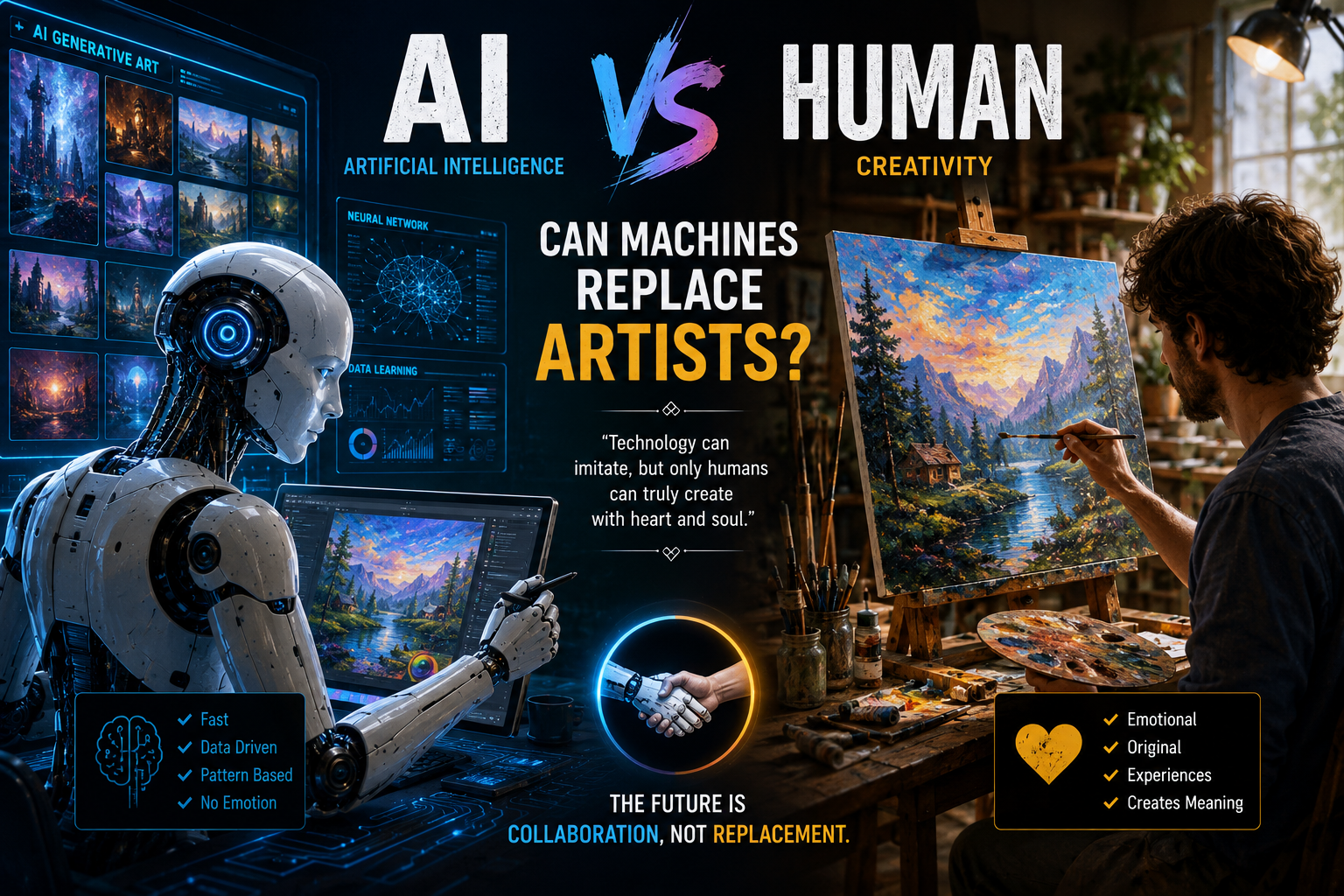
Although AI can generate impressive content, human creativity is driven by emotion, personal experiences, imagination, and cultural understanding. Artists create not only to produce something visually appealing but also to express feelings, tell stories, and connect with audiences on a deeper level.
A painting created by a human often carries emotional meaning shaped by life experiences. Music written by a composer may reflect heartbreak, hope, or social struggles. These emotional layers are difficult for machines to genuinely understand because AI does not possess consciousness or real emotions.
Human creativity also thrives on originality and unpredictability. Artists break rules, challenge traditions, and create entirely new movements. AI, on the other hand, relies heavily on existing data and patterns, meaning it often remixes rather than invents truly original ideas.
AI as a Creative Partner, Not a Replacement
Rather than replacing artists completely, AI is more likely to become a collaborative tool. Many designers, writers, filmmakers, and musicians already use AI to enhance their workflow. AI can help brainstorm concepts, generate drafts, improve editing, or create visual references, allowing creators to focus on deeper artistic decisions.
For example, a digital artist might use AI to generate background concepts before refining them manually. A musician may use AI-generated melodies as inspiration for a full composition. In this way, technology becomes an assistant that expands creative possibilities instead of eliminating human talent.
This partnership between humans and AI could lead to entirely new art forms where creativity is shared between machine intelligence and human imagination.
The Challenges and Ethical Concerns
The growth of AI-generated art also creates ethical and professional concerns. Many artists worry about copyright issues because AI systems are often trained using existing artworks without permission. Others fear job displacement as businesses may prefer cheaper AI-generated content over hiring professionals.
There is also debate about authenticity. Audiences may question whether AI-generated works have the same emotional or cultural value as human-made creations. While AI can mimic artistic styles, critics argue that it lacks true intent and meaning.
Governments, technology companies, and creative communities continue to discuss how to balance innovation with protecting artists’ rights and originality.
Conclusion
AI is undoubtedly reshaping the creative world, but it is unlikely to fully replace human artists. Machines can generate content quickly and efficiently, yet they still lack genuine emotion, personal experience, and human perspective. Creativity is more than producing images or music—it is about storytelling, expression, and connection.
The future of creativity will likely involve collaboration rather than competition. AI can serve as a powerful creative assistant, while humans remain the heart of artistic innovation and emotional depth.