Category: Machine Learning & Cognitive Science | Research Article
Introduction: Understanding the Intelligence Behind AI
Artificial intelligence has made remarkable progress in recent years. Advanced language models can solve mathematical problems, write computer programs, explain scientific concepts, analyze documents, and complete tasks that require multiple steps. These capabilities raise an important scientific question: Can AI genuinely reason through a problem, or does it primarily recognize patterns learned from its training data?
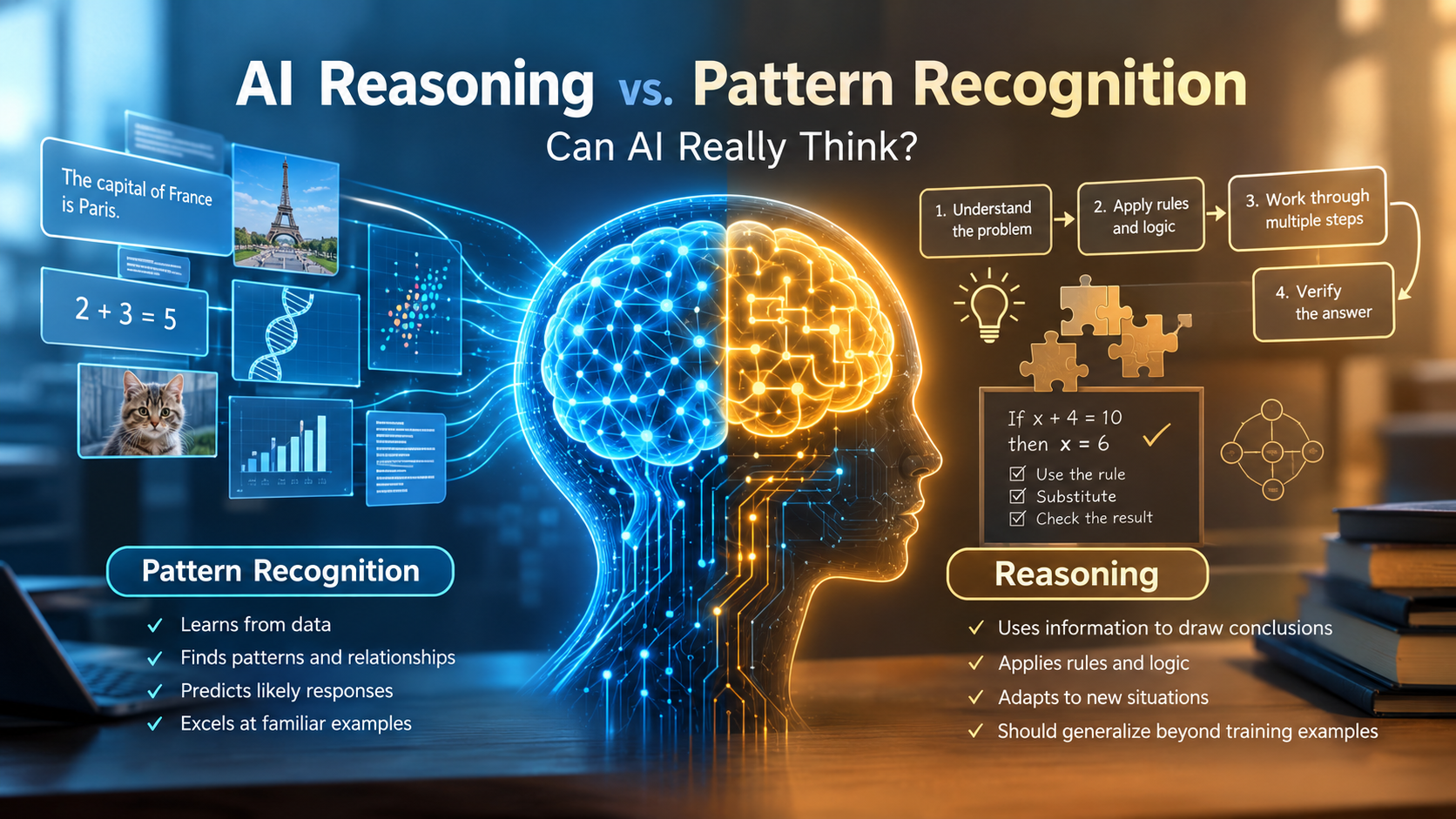
The distinction between AI reasoning and pattern recognition is central to understanding modern machine learning. Pattern recognition allows an AI system to identify relationships, similarities, structures, and recurring features in information. Reasoning involves using information to reach conclusions, evaluate possibilities, apply rules, and solve problems that may require several connected steps.
These abilities are not necessarily opposites. Human cognition also relies on both pattern recognition and deliberate reasoning. Similarly, language models may combine learned statistical patterns with computational procedures that support complex problem-solving. The challenge is determining when their performance reflects robust reasoning and when it depends on familiar patterns, memorized examples, or fragile shortcuts.
This article examines the scientific debate, the capabilities and limitations of modern language models, and the experiments researchers can use to distinguish reliable reasoning from sophisticated pattern matching.
1. What Is AI Pattern Recognition?

Pattern recognition is the process of identifying regularities in data. It is a fundamental component of machine learning, computer vision, speech recognition, recommendation systems, and natural language processing.
During training, a language model processes enormous quantities of text and learns statistical relationships among words, concepts, sentence structures, and other elements. Rather than storing every possible response as a complete answer, it learns parameters that help it predict likely continuations and represent relationships within language.
For example, a model may learn that a question beginning with “What is the capital of France?” is commonly answered with “Paris.” It may also learn mathematical notation, the structure of scientific explanations, and the steps frequently used to solve algebraic equations.
Pattern recognition can be highly sophisticated. A model may recognize abstract relationships rather than simply matching identical sentences. It can identify analogies, infer likely meanings from context, and apply familiar structures to new examples.
However, recognizing a pattern is not the same as demonstrating that a solution method will remain reliable when the problem changes substantially.
How pattern recognition works
A typical machine-learning process involves three major stages.
Training: The model adjusts its internal parameters to learn statistical relationships from examples.
Inference: When given a new input, the model uses its learned parameters to generate a prediction or response.
Generalization: The model applies what it learned to examples that were not encountered during training.
Successful generalization is important because a model that only reproduces familiar examples has limited practical value. Yet even strong performance on unseen examples does not automatically establish that a model uses robust, systematic reasoning.
2. What Is AI Reasoning?
AI reasoning refers to the ability to use available information to derive conclusions, solve problems, and make decisions through connected steps.
Reasoning can involve several different processes, including deductive reasoning, inductive reasoning, analogical reasoning, mathematical reasoning, and causal reasoning.
Deductive reasoning applies general rules to particular cases. For example, if all mammals are warm-blooded and whales are mammals, then whales are warm-blooded.
Inductive reasoning identifies broader patterns from observations. It may suggest that a relationship is likely, although the conclusion is not guaranteed.
Analogical reasoning transfers a relationship from one situation to another. Mathematical reasoning applies definitions, equations, and logical operations to derive results.
Causal reasoning investigates whether one event produces another rather than merely occurring alongside it.
In AI research, a crucial distinction is between producing an answer that looks like a reasoned conclusion and arriving at a conclusion through a process that is logically sound, appropriately grounded, and robust to changes in the problem.
A language model may generate a convincing explanation but still make an invalid inference. Consequently, researchers need to evaluate not only the final answer but also the consistency, validity, and reliability of the solution process.
3. The Core Difference Between Reasoning and Pattern Recognition
Although these processes overlap, researchers can distinguish them by examining how a model behaves when a task changes.
| Feature | Pattern recognition | Reliable reasoning |
|---|---|---|
| Primary function | Identifies learned relationships | Derives conclusions through connected steps |
| Familiar problems | Often performs well | Often performs well |
| Unfamiliar problems | May struggle with changed patterns | Should generalize when the underlying logic remains valid |
| Rule changes | May continue using an outdated pattern | Should adapt to the new rule |
| Contradictory information | May produce inconsistent answers | Should identify relevant contradictions |
| Verification | May generate plausible explanations | Should support conclusions with valid steps or independent checks |
This comparison is an idealized distinction, not a strict separation between two kinds of AI. Pattern recognition can support reasoning, and a reasoning system can use learned patterns to choose useful strategies.
The important research question is whether the system has learned a transferable problem-solving capability or merely a collection of strategies that work under familiar conditions.
Consider a simple example.
A model is shown several problems in which adding two numbers produces a sum. It learns to solve \(3+4=7\) and \(8+5=13\). Now imagine that the instructions introduce a fictional number system in which the symbol \(+\) means multiplication.
A model that follows the newly defined rule should calculate \(3+4=12\) under that system. A model that automatically applies ordinary arithmetic may answer 7.
This test does not prove that a model lacks reasoning if it fails once. Instead, it tests whether the model can follow a new rule rather than relying on a highly familiar association.
4. Can Large Language Models Perform Multi-Step Reasoning?

Large language models can solve many problems that require multiple connected operations. Their capabilities include mathematical problem-solving, code generation, logical deduction, planning, and analysis of complicated instructions.
One influential technique is chain-of-thought prompting, in which a model is encouraged to break a problem into intermediate steps before producing its answer. This approach can improve performance on certain reasoning tasks because it gives the model room to construct and evaluate intermediate results.
However, producing a sequence of steps is not proof that those steps faithfully represent the process responsible for the answer.
Research from Anthropic, published in 2023, examined whether the reasoning explanations generated by language models accurately reflected their answer-producing processes. The researchers found that explanations could be unfaithful in some circumstances, with substantial variation across tasks. Read the Anthropic research.
This finding highlights three important distinctions.
First, a model can produce a correct answer using an unreliable method. Second, a model can provide a convincing explanation that does not accurately describe how the answer was reached. Third, a model can use valid reasoning on one problem and fail on a closely related problem.
These differences matter because real-world systems need more than occasional success. They need consistent performance across varied inputs, changing conditions, and situations where an incorrect answer could cause harm.
Does more computation improve reasoning?
Some AI systems are designed to spend additional computation evaluating possibilities or developing intermediate solutions before answering. This can improve accuracy on difficult problems.
Yet extra computation does not automatically guarantee correctness. A model can spend more time following a mistaken assumption, repeating an invalid inference, or generating increasingly elaborate but incorrect explanations.
Reliable reasoning therefore requires more than lengthy answers. It requires appropriate problem-solving methods, useful intermediate representations, and effective verification.
5. What Recent Research Reveals
Research published in 2025 and 2026 has continued to investigate whether language models learn robust reasoning skills or depend heavily on patterns in their training data.

Chain-of-thought reasoning and training distributions
Research published in Findings of ACL 2026 examined the relationship between chain-of-thought reasoning and the distribution of training examples. Its experiments suggest that reasoning performance can become brittle when tasks move beyond familiar training distributions. This supports the importance of testing models on structurally different problems, rather than relying only on familiar formats.

Testing reasoning without benchmark memorization
BeyondBench, presented at ICLR 2026, uses algorithmically generated problems to reduce the risk that models succeed by memorizing public benchmark examples. Its framework covers 44 algorithmic tasks and 117 variations, including arithmetic, sequence reasoning, and constraint-satisfaction problems.

How training shapes mathematical generalization
A 2025 study published in the Proceedings of Machine Learning Research investigated how fine-tuning affects mathematical reasoning. The researchers examined the relationship between learning dynamics, copying training examples, and performance on unseen problems. The work emphasizes that fitting training data and generalizing to new examples are different capabilities.
Proceedings of Machine Learning Research
Research: What Do Learning Dynamics Reveal About Generalization in LLM Mathematical Reasoning?
Taken together, these studies support a measured conclusion: strong benchmark performance is evidence of capability, but it does not by itself establish robust, general-purpose reasoning. The strength of the evidence depends on how the tasks are designed and whether alternative explanations, including memorization and distribution-specific shortcuts, have been ruled out.
6. How Can Researchers Test Whether AI Is Really Reasoning?
Researchers need carefully designed experiments to separate memorization, pattern recognition, and generalizable problem-solving. Simply asking a model difficult questions is not enough.
Experiment 1: Test with completely new problems
Researchers can create mathematical or logical problems after a model has been trained. Each problem should be generated from known rules but use new numbers, structures, or combinations.
For example, rather than asking a familiar arithmetic question, an evaluator might generate hundreds of problems with different numbers of steps and increasing complexity.
If the model succeeds consistently on newly generated problems, this provides stronger evidence of generalization than success on a fixed public test. However, novel surface details alone are insufficient if the underlying task is still very familiar.
Experiment 2: Change the rules
A researcher can introduce an unfamiliar rule and test whether the model follows it consistently.
For example, the model could be instructed to sort numbers from largest to smallest rather than smallest to largest. The evaluator can then introduce additional examples and check whether the model continues applying the revised rule.
This tests instruction following, rule adaptation, and consistency. Researchers should also test whether the model can explain and apply the rule when the examples become more complex.
Experiment 3: Increase the number of reasoning steps
A model might solve a two-step problem accurately but struggle when the same task requires ten or twenty dependent steps.
Researchers can measure how accuracy changes as the number of operations increases. They can also introduce distractors, irrelevant details, and intermediate results that must be retained.
A gradual decline in performance may reveal limits in working with long chains of dependent calculations. A sudden failure at a particular length can indicate a specific bottleneck.
Experiment 4: Introduce misleading information
Researchers can include irrelevant or contradictory statements in a question and evaluate whether the model identifies the information that actually matters.
A reliable system should distinguish assumptions from established facts, recognize when evidence is insufficient, and avoid treating every statement as equally trustworthy.
Experiment 5: Verify every intermediate step
The final answer is only one measure of performance. Researchers can independently check calculations, logical inferences, and the evidence supporting each conclusion.
A model that produces a correct final answer through an invalid intermediate argument may be less reliable than its score suggests. However, a written explanation is not necessarily a faithful record of the internal computation, so independent verification and controlled interventions are important.
7. Why Do AI Models Fail at Reasoning?

Several factors can cause language models to fail even when they appear highly capable.
Dependence on familiar examples: Models learn from training distributions. When a problem differs substantially from the examples that shaped their learned strategies, performance may deteriorate.
Accumulation of errors: Multi-step problems depend on intermediate results. An incorrect assumption or calculation early in the process can invalidate later steps.
Context limitations: Long problems may require retaining many constraints, relationships, and intermediate results. Important information can be overlooked or used inconsistently.
Plausible but incorrect explanations: Language models are capable of generating fluent, authoritative-sounding text. Fluency, detail, and confidence do not guarantee logical validity.
Benchmark contamination: A benchmark may contain questions or solutions that overlap with training data. If so, a high score may partly reflect prior exposure rather than the intended capability. Research on contamination-resistant evaluation seeks to address this problem.
Unreliable self-correction: Asking a model to check its own answer can help, but self-review does not guarantee that it will identify its mistakes. Independent calculations, formal verification, external tools, or a separate evaluator can provide additional safeguards.
These limitations do not mean that language models cannot reason. They demonstrate why reasoning capability should be measured across multiple tasks and conditions rather than inferred from a single impressive result.
8. Can AI Combine Pattern Recognition with Logical Reasoning?
The most promising direction is not necessarily to eliminate pattern recognition. Instead, it is to combine learned representations with methods that support more reliable problem-solving.
A language model can identify the type of problem, propose a solution strategy, and translate a request into a sequence of operations. Other components can then verify the results.
For example, a mathematics assistant could interpret a question in natural language, formulate an equation, use a symbolic mathematics engine to solve it, and check whether the result satisfies the original equation.
Similarly, a coding assistant could generate a program, execute tests, analyze errors, and revise its implementation. An AI planning system could propose a sequence of actions and use a constraint solver to determine whether those actions are feasible.
This approach is often more reliable than expecting a language model to perform every operation internally.
The key principle is that learned intelligence and explicit verification can complement one another. Pattern recognition helps identify useful strategies, while formal rules, external tools, and independent checks can catch errors.
Nevertheless, tool use introduces its own risks. A model may choose an inappropriate tool, misunderstand its output, or make an incorrect assumption before verification begins. The entire process must therefore be evaluated.
9. Applications in Education, Healthcare, and Scientific Research
The distinction between reasoning and pattern recognition has practical implications across several fields.

Education and personalized tutoring
AI tutors can recognize student errors, adapt explanations, and generate practice questions. To be dependable, they must also distinguish valid solutions from convincing but incorrect ones. Teachers should verify important explanations and encourage students to check the logic independently.

Healthcare and clinical decision support
Pattern recognition can help identify features in medical images and patient records. Clinical reasoning additionally requires consideration of patient history, alternative diagnoses, uncertainty, and conflicting evidence. AI outputs should support, not replace, appropriate professional judgment.

Scientific discovery
AI can identify patterns in large datasets, suggest hypotheses, and help researchers explore possible explanations. Stronger evidence comes from testing predictions, reproducing results, and comparing hypotheses against experimental observations.

Software engineering
AI coding systems can recognize common programming patterns and generate complex implementations. Reliable performance requires testing, debugging, security analysis, and checking whether the software meets its actual requirements.
Across these applications, the goal is not merely to produce an answer that appears intelligent. It is to produce an answer that remains accurate when tested against evidence, rules, and real-world constraints.
10. Future Research: Toward More Reliable AI Reasoning
Future research should focus on several interconnected questions.
First, researchers need better ways to measure generalization. Tests should include procedurally generated problems, unfamiliar rules, longer reasoning chains, and changes in the structure of tasks.
Second, AI systems need stronger verification methods. Formal logic, mathematical solvers, program execution, and independent evaluators can help identify errors that ordinary language generation misses.
Third, researchers must improve the evaluation of explanations. A model’s written reasoning should not automatically be treated as a complete or faithful account of the process behind its answer. Work such as the 2026 FaithCoT-Bench project explores methods for detecting unfaithful reasoning traces.
Fourth, systems should become better at recognizing uncertainty. A reliable AI should be able to indicate when a question is ambiguous, when evidence is inadequate, and when a conclusion depends on an unverified assumption.
Finally, research should investigate how reasoning transfers across domains. Success in mathematical puzzles does not necessarily imply reliable causal reasoning, scientific judgment, or long-term planning. Each capability requires suitable evaluation.
The broader challenge is to build AI systems that can generalize, check their own work effectively, use external evidence appropriately, and remain dependable under unfamiliar conditions.
Conclusion: Is AI Reasoning More Than Pattern Recognition?
The debate over AI reasoning versus pattern recognition cannot be settled by treating the two as mutually exclusive. Modern language models learn sophisticated statistical representations that support impressive problem-solving capabilities. They can perform many multi-step tasks, and some of their abilities generalize beyond exact examples seen during training.
At the same time, research demonstrates that fluent explanations, high benchmark scores, and correct answers do not always establish robust reasoning. Models can depend on familiar patterns, struggle when task distributions change, and produce explanations that do not faithfully reflect their answer-generating processes.
The strongest approach is to evaluate AI through controlled experiments that test unfamiliar problems, changed rules, longer solution chains, and independent verification. Rather than asking only whether an AI can answer a question, researchers should ask whether it can solve the problem consistently, explain its assumptions accurately, and produce results that withstand scrutiny.
Ultimately, the goal of AI research is not simply to create systems that imitate intelligent behavior. It is to develop systems whose capabilities are measurable, generalizable, transparent enough to evaluate, and reliable enough for their intended applications.