

6
Introduction: A New Era of AI-Powered Physics
Artificial intelligence is becoming an increasingly important tool in modern scientific research, helping researchers analyze complex data, identify hidden patterns, and accelerate discoveries that would otherwise require enormous amounts of time and computing power. One promising application is high-energy particle physics, where experiments generate vast quantities of information about the fundamental building blocks of the universe.
On October 15, 2026, CERN and Mistral AI were reported to have announced a partnership to develop an AI foundation model for collider physics using simulated particle collisions. The proposed direction reflects a growing interest in specialized AI systems designed to understand scientific data rather than simply generate text or images.
An important note: I could not independently verify the specific October 15 announcement here, so the partnership details should be treated as reported rather than fully confirmed. The scientific applications discussed below are based on established particle-physics research methods and the potential of foundation models.
What Is CERN, and Why Does Particle Physics Need AI?

The European Organization for Nuclear Research (CERN) operates some of the world’s most advanced particle-physics facilities, including the Large Hadron Collider (LHC). Located near Geneva on the Swiss–French border, the LHC accelerates particles to extremely high energies and collides them to investigate matter, energy, and the fundamental forces of nature.
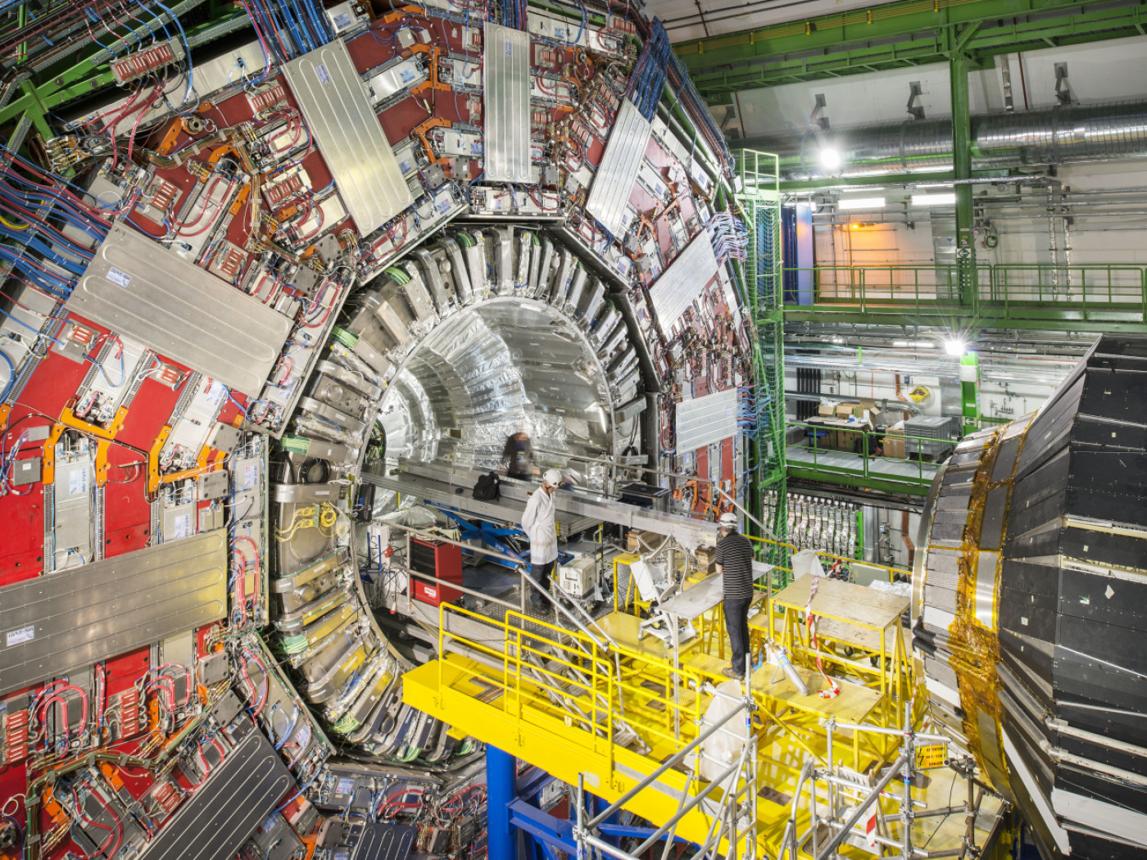
These collisions can produce showers of secondary particles that travel through sophisticated detectors. Instruments such as ATLAS and CMS record signals that physicists reconstruct into information about particle energies, directions, and identities.
The challenge is scale. The LHC produces enormous volumes of detector data, while only a fraction of collision events can be stored for detailed analysis. Researchers must rapidly decide which events deserve closer examination, reconstruct the particles involved, and distinguish potentially important signals from ordinary physical processes and detector noise.
Traditional algorithms remain essential, but AI could help scientists extract more information from these increasingly complex experiments.
How the AI model could help physicists

1. Reconstructing particle collisions
AI could transform raw detector signals into a more complete picture of the particles produced during a collision, helping physicists understand what happened inside the detector.

2. Identifying particles
By learning patterns in simulated collisions, a model could help distinguish particle types and estimate properties such as momentum and energy.

3. Detecting unexpected signals
AI could flag unusual collision patterns for further investigation. These anomalies might reveal interesting physics, although detector problems and known processes must first be ruled out.

4. Improving future experiments
Researchers could use AI to evaluate simulated detector designs, compare configurations and investigate how engineering choices affect the quality of future measurements.
These are among the intended applications described in CERN’s official announcement.
Why train AI on simulated collisions?
The planned model, described by Reuters as Flare, would learn from billions of simulated proton–proton collisions instead of conventional text datasets.
Simulations are valuable because scientists know the underlying conditions used to generate each example. They can therefore compare a model’s predictions with the expected results and measure its accuracy.
However, simulations cannot reproduce every detail of real experiments perfectly. Researchers will need to test the model on actual detector data and account for noise, calibration differences and other uncertainties.
The scale of CERN’s data challenge
~1 EB
Experimental data stored from the LHC
~1 million TB
Equivalent data volume
CERN expects the number of collisions to increase substantially with the High-Luminosity LHC, planned to begin operating around 2030. The exact computing challenge will depend on the experiment and its processing requirements.
Source: CERN and Reuters, October 15, 2026.
A shared foundation model could potentially replace parts of today’s multi-stage reconstruction pipelines with a more unified system. That might simplify some workflows and help researchers process increasingly complex events.
Nevertheless, better AI does not automatically mean faster or cheaper science. The model must demonstrate improvements in accuracy, computing efficiency and reliability before physicists can establish its practical value.
Challenges and limitations
Several questions remain open. Can the model generalise from simulated collisions to real detector measurements? Can scientists understand why it identifies a particular event as unusual? Will it perform reliably across different collision conditions? And will the computing resources required to operate it be practical for research teams?
Human expertise will remain essential. Physicists must validate results, quantify uncertainty, compare competing explanations and determine whether an apparent discovery is supported by evidence.
As of October 22, 2026, CERN’s announcement establishes the partnership’s ambition, not a completed model with demonstrated scientific results. The announcement did not provide a development timeline or budget.
Conclusion
CERN’s collaboration with Mistral AI represents an important direction in scientific computing: developing AI that learns directly from the structures and patterns of scientific data.
If successful, a Large Physics Model could help researchers reconstruct particle collisions, identify particles, flag unusual events and explore future detector designs using a shared AI foundation. These capabilities could make it easier to extract scientific value from the enormous datasets produced by modern experiments.
The ultimate test, however, will not be how impressive the model sounds. It will be whether independent scientific evaluation shows that it produces more accurate, efficient and trustworthy results.
The larger opportunity: AI may not replace physicists, but it could give them better tools to investigate some of the universe’s deepest questions.