Scientific Research · Neuroscience · AI in Healthcare · Drug Discovery
Scientific research is entering a new phase in which artificial intelligence can help researchers explore millions of biological observations, connect findings across scientific publications, and identify questions that deserve further investigation. On October 21, 2026, OpenAI announced a collaboration with PerturbAI and Scripps Research that used thousands of AI agents to analyze experimental data from millions of mouse brain cells in just 32 minutes.
The research raises an important question: Could multi-agent AI accelerate discoveries about Alzheimer’s disease and Parkinson’s disease? The approach offers promising possibilities for neuroscience and drug discovery, although its findings are still research leads rather than proven treatments.


How thousands of AI agents analyzed brain-cell data
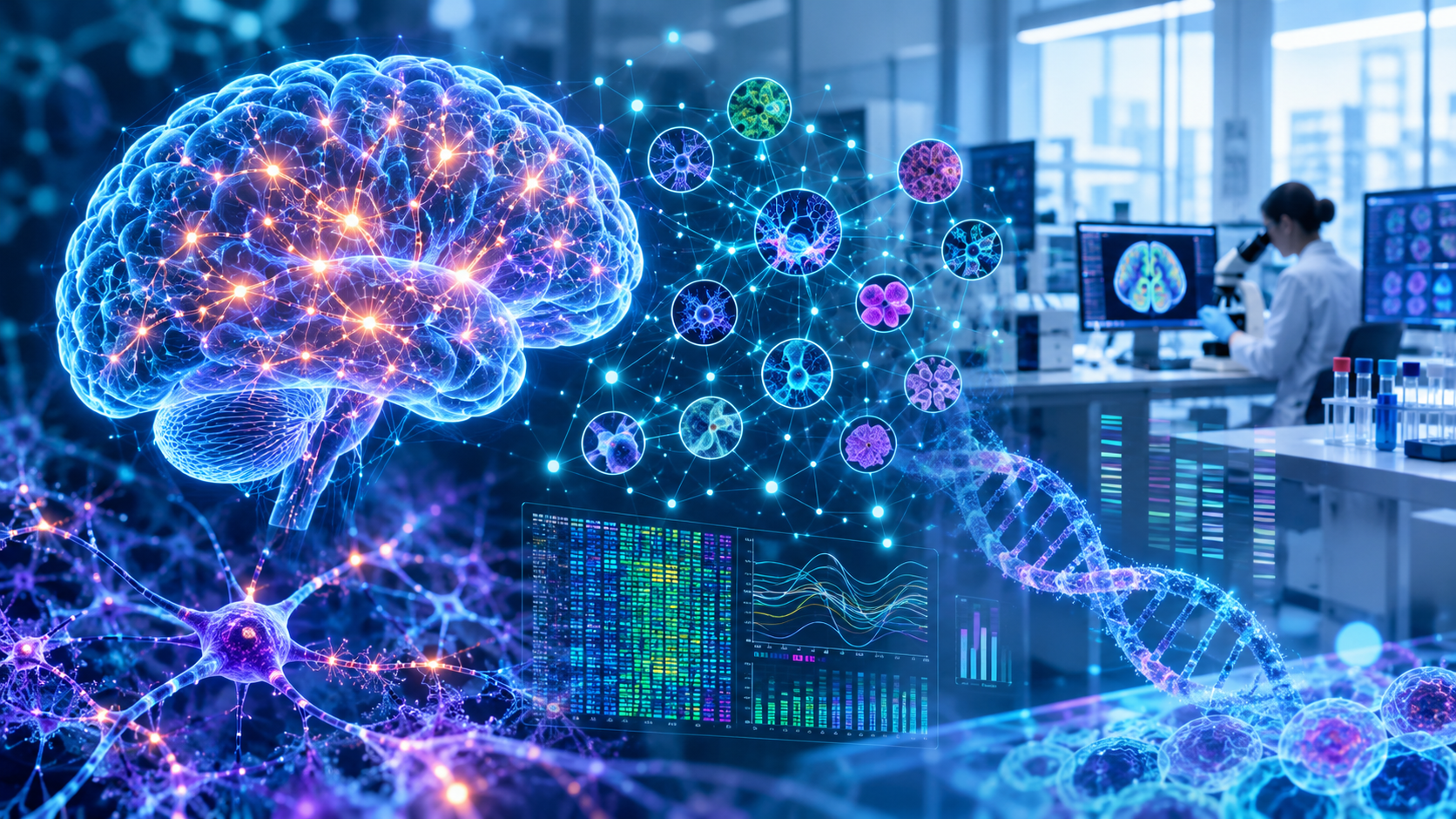
The research team used a method called distributed biological reasoning. Instead of asking one AI system to interpret the entire dataset, the researchers divided the work among thousands of specialized AI agents powered by GPT-Rosalind. Each agent investigated a particular gene disruption, examined the resulting cellular changes, searched scientific publications, and proposed possible biological explanations. Their reports were then combined into a searchable reasoning atlas.
Key findings at a glance
32 minutes
Reported analysis time
1,946
AI agents working in parallel
Millions
Mouse brain cells represented in the data
75%
Frequency with which experts preferred distributed-agent reports over single-agent reports
Figures reported by OpenAI and its research collaborators. The comparison concerns data interpretation, not clinical outcomes.
The team estimated that comparable human analysis and literature review, performed sequentially, could take months to a year. This is an estimate rather than a controlled demonstration that the same research would take that long in every laboratory.
Could this accelerate Alzheimer’s and Parkinson’s research?

Alzheimer’s disease
Alzheimer’s research involves complex interactions among neurons, immune cells, proteins, genes, and metabolism. Multi-agent AI could help scientists connect gene-related cellular changes with published research, identify overlooked patterns, and develop hypotheses about disease mechanisms. Researchers would still need to establish whether those patterns are relevant to human Alzheimer’s disease.

Parkinson’s disease
Parkinson’s involves the loss or dysfunction of dopamine-producing neurons and can involve genetic, cellular, and metabolic processes. The AI study identified a potential connection between the neurodegeneration-related gene DCTN1 and cholesterol production. This could motivate research into cholesterol transport within neurons, but it does not establish that cholesterol changes cause Parkinson’s disease or that changing cholesterol would prevent it.
Why multiple agents may outperform a single AI system
A single AI system processing an enormous dataset must divide its attention among many genes, cellular responses, and research papers. In the reported comparison, the single-agent approach retrieved only 11 references at the largest workload, while the distributed approach retained thousands of references across its reports. The researchers also found that blinded biology experts preferred the distributed-agent interpretations 75% of the time.
The advantage is not simply that more AI systems run simultaneously. Each agent can focus on a narrower question, investigate relevant literature, and contribute a more specialized report. Combining these reports may reveal connections that would be difficult to identify by examining isolated findings.
However, parallel processing does not automatically guarantee accuracy. Agents can still misunderstand scientific papers, overlook contradictory evidence, or generate explanations that sound convincing but are biologically incorrect. Human expertise and experimental validation remain essential.
From biological clues to future treatments
The most important potential benefit is a shorter path from large-scale experiments to promising follow-up studies.
- Identify research targets: Detect genes and cellular processes that may contribute to disease.
- Connect different fields: Link neuroscience, genetics, metabolism, and existing scientific publications.
- Prioritize experiments: Help researchers decide which hypotheses are worth testing first.
- Improve drug discovery: Generate possible therapeutic targets for further laboratory investigation.
For Alzheimer’s and Parkinson’s, the next step is to test whether AI-generated hypotheses hold up in additional experiments, human-derived cells, disease models, and eventually appropriately designed clinical studies. The current findings do not demonstrate a new treatment or prove that the approach will reduce the time required to develop an effective medicine.
Limitations and unanswered questions
The announcement describes promising computational research, but several important questions remain. The underlying study was published as a preprint, which means it had not yet completed formal peer review at the time of the announcement. The analysis also used mouse-brain data, and biological findings in mice do not necessarily translate directly to humans.
Future evaluations will need to measure whether the generated hypotheses are reproducible, whether they lead to successful experiments, and whether the approach offers consistent benefits across different datasets and diseases. Researchers must also consider computational costs, data quality, and the possibility that automated literature searches may reinforce existing scientific biases.
Conclusion
Thousands of AI agents working together could help scientists investigate biological data at a scale that would otherwise be difficult to manage. The collaboration between OpenAI, PerturbAI, and Scripps Research demonstrates how parallel AI analysis can connect experimental observations with scientific literature and generate new research directions.
For Alzheimer’s and Parkinson’s disease, the greatest promise is not an immediate cure but a more efficient way to discover and prioritize biological questions. If future experiments validate these leads, multi-agent AI could become a valuable tool in neuroscience and drug discovery, helping researchers spend more time testing meaningful ideas and less time manually searching through enormous volumes of data.