

AI Chatbot: Exploring Intelligent Conversations, Modern Technology, and the Future of Digital Interaction 🤖💬🚀
Artificial intelligence has changed the way people interact with technology. For many years, computers primarily responded to carefully structured commands, menus, and buttons. Today, people can communicate with software using ordinary language. They can ask questions, request information, receive recommendations, solve problems, and complete digital tasks through conversational interfaces.
At the center of this transformation is the AI chatbot.
An AI chatbot is a software system designed to communicate with users through text, voice, or other conversational interfaces. Modern chatbots can use artificial intelligence, machine learning, natural language processing, and increasingly sophisticated language models to understand user requests and generate useful responses.
The concept is not entirely new. Early conversational programs existed decades ago, but modern AI has dramatically expanded what chatbots can do. Instead of responding only to a limited set of predetermined commands, advanced systems can interpret a wide range of questions and generate contextually relevant responses.
This development has created opportunities across education, business, customer service, healthcare, software development, entertainment, research, and personal productivity. 🌍💡
However, understanding AI chatbots requires more than recognizing their convenience. Users and developers should also understand how these systems work, what they can do, where they can make mistakes, and how they should be used responsibly.
This article explores the world of AI chatbots, from basic concepts and technology to practical applications, benefits, limitations, security, responsible AI, and the future of conversational computing.
What Is an AI Chatbot? 🤖💬
An AI chatbot is a digital system that communicates with people through conversational interaction.
The word “chatbot” combines “chat” and “robot,” although the software itself is not a physical robot. Instead, it is an application or service capable of receiving user input and producing responses.
Traditional chatbots often relied on predefined rules.
For example, a simple customer-service chatbot might recognize the words “opening hours” and return a predetermined message.
Modern AI chatbots can be much more flexible.
They can interpret questions expressed in different ways and generate responses based on patterns learned from large datasets or information provided to the system.
A user might ask:
“What time do you close?”
“Are you open this evening?”
“Can I visit after work?”
A sophisticated conversational system may recognize that all three questions relate to business hours even though the wording differs.
This ability to interpret natural language is one of the characteristics that makes modern AI chatbots powerful.
Many advanced chatbots are built using large language models. These models process text as sequences of tokens and use learned statistical relationships to predict and generate language.
Some systems can also process images, audio, documents, and other forms of information.
As a result, the concept of an AI chatbot is expanding beyond simple text conversations toward broader conversational assistants. 🧠✨
How AI Chatbots Understand Human Language 📝🧠
Human language is complicated.
People frequently use incomplete sentences, slang, abbreviations, humor, cultural references, and ambiguous expressions.
A useful chatbot therefore needs more than a simple keyword-matching system.
Natural language processing, or NLP, is an important area of artificial intelligence that helps computers process human language.
NLP techniques can be used for tasks such as text classification, language understanding, information extraction, translation, summarization, and question answering.
Modern AI systems often use neural networks to process language.
Large language models are trained on substantial collections of text and learn patterns in how language is structured.
They do not understand language in exactly the same way humans do. Instead, they perform complex mathematical computations that allow them to identify relationships among tokens and generate plausible sequences.
Context is particularly important.
Suppose someone asks:
“Who directed that movie?”
A chatbot may need to know which movie “that movie” refers to based on previous conversation.
Maintaining conversational context allows interactions to feel more natural.
However, context handling has limits. A system may lose track of earlier information, misunderstand ambiguous references, or incorrectly interpret what the user intended.
This is why clear communication remains useful even when interacting with sophisticated AI.
The Technology Behind Modern Chatbots 💻⚙️
Several technologies can contribute to an AI chatbot.
Machine learning provides methods for systems to learn patterns from data.
Neural networks provide computational structures capable of processing complex information.
Natural language processing provides techniques for working with human language.
Large language models provide powerful generative capabilities.
Retrieval systems can allow chatbots to access relevant information from documents or databases.
Speech-recognition technology can convert spoken language into text.
Text-to-speech systems can convert generated responses into spoken language.
Together, these technologies can create conversational experiences that feel significantly more capable than earlier rule-based bots.
A typical AI chatbot workflow might look conceptually like this:
User input → language processing → context analysis → information retrieval or model reasoning → response generation → output
In a more advanced system, additional steps may occur.
The chatbot could check a knowledge base, use a search system, call an external application, analyze an uploaded document, or perform a specific computational task.
This creates a distinction between a chatbot that simply generates text and an AI assistant capable of interacting with external tools.
Tool integration is increasingly important because users often want chatbots to do things rather than merely discuss them.
For example, a conversational system could potentially help organize information, summarize documents, retrieve data, or interact with business software when appropriate permissions and integrations exist.
AI Chatbots in Customer Service 🎧💬
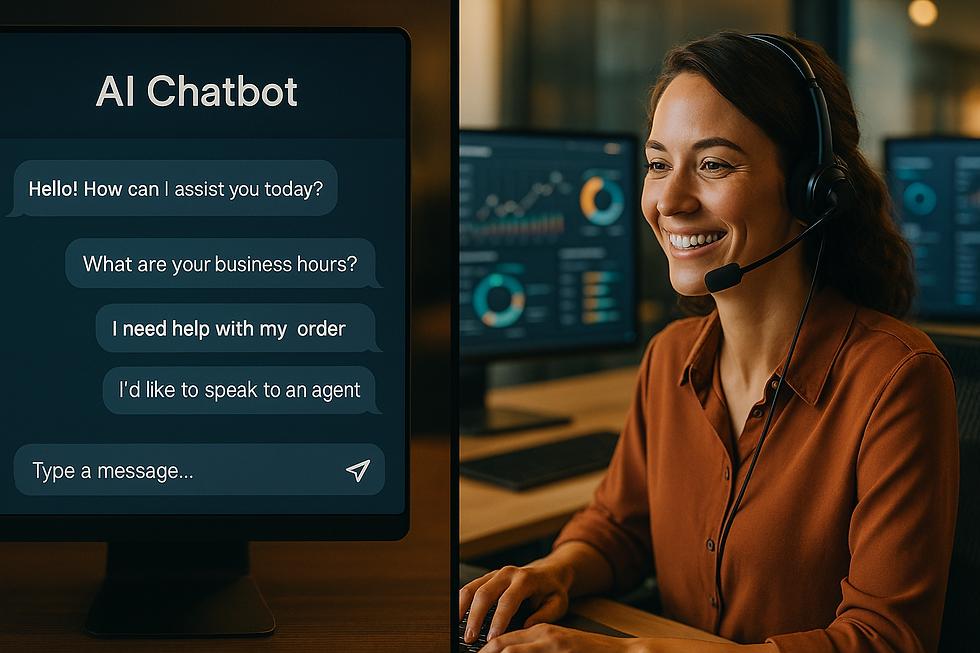
Customer service is one of the most common applications of chatbot technology.
Businesses receive large numbers of repetitive questions.
Customers may ask about delivery times, account procedures, product information, operating hours, return policies, or basic troubleshooting.
An AI chatbot can provide immediate responses to many routine questions.
This can make customer support available outside traditional business hours.
A chatbot can also help direct customers toward relevant information before a human agent becomes involved.
For example, a customer might describe a technical problem in conversational language. The chatbot can identify possible troubleshooting steps and, when necessary, direct the conversation to a human representative.
This hybrid model can be useful.
AI handles straightforward interactions while people focus on complicated, sensitive, or unusual situations.
However, businesses should avoid assuming that every customer-service problem should be automated.
Customers can become frustrated when a chatbot repeatedly fails to understand a problem or prevents them from reaching a human representative.
Good chatbot design therefore includes clear escalation paths.
Users should know when and how they can request human assistance.
The goal should not simply be reducing human involvement.
The goal should be improving the overall customer experience. 🌟
AI Chatbots in Education 🎓📚
Education is another area where conversational AI can provide useful assistance.
Students can use chatbots to ask questions about concepts, request explanations, brainstorm ideas, practice languages, generate study questions, or review material.
An AI chatbot can potentially provide personalized explanations.
If a student does not understand a concept, they can ask for a simpler explanation.
They might then request an analogy, an example, or a practice problem.
This conversational format can make learning more interactive.
Teachers and educational institutions can also explore AI for administrative tasks, tutoring support, information retrieval, and student services.
However, AI in education should be used thoughtfully.
Students need to develop their own reasoning abilities.
If learners simply copy chatbot responses without understanding them, technology can undermine learning rather than support it.
AI-generated information can also contain errors.
Students should therefore verify important claims and use AI as a learning aid rather than automatically treating every response as authoritative.
Educators can teach students how to ask better questions, evaluate AI outputs, identify errors, and use AI ethically.
This creates an opportunity to develop AI literacy alongside traditional academic skills. 🧠✨
AI Chatbots for Business Productivity 💼🚀
Businesses are increasingly interested in conversational AI because employees spend significant amounts of time searching for information and performing repetitive tasks.
An internal chatbot can potentially help employees find company information, summarize documents, explain procedures, or locate relevant resources.
Imagine an employee asking:
“What is the process for submitting this type of request?”
Instead of searching through multiple internal documents, the employee could receive a conversational answer based on approved company information.
This type of system can reduce information friction.
AI chatbots can also support brainstorming, writing assistance, meeting summaries, data interpretation, and software development.
However, business deployment requires careful consideration of privacy and security.
Organizations need to understand what information the system can access, where data is processed, who can use the system, and how sensitive information is protected.
An AI chatbot should not automatically receive access to every company database.
Access controls should follow the principle of giving systems only the permissions necessary for their intended tasks. 🔐
AI Chatbots and Personal Productivity 📅✨
AI chatbots can also function as personal productivity tools.
Users can ask for help organizing ideas, creating schedules, summarizing information, drafting messages, explaining difficult concepts, or brainstorming solutions.
Conversational interaction can be useful because users do not always know exactly what tool they need.
Instead of learning a complex interface, they can describe what they want in ordinary language.
For example, a user might say:
“I have several tasks this week. Help me organize them by urgency.”
A chatbot can then help structure the information.
The user remains responsible for deciding whether the proposed organization makes sense.
This distinction is important.
AI can assist with planning, but it does not necessarily know all of the user’s priorities, constraints, or real-world circumstances.
Human judgment remains essential.
The best productivity systems therefore combine automation with user control.
AI Chatbots and Software Development 👨💻🤖
Software development is another field where AI chatbots can provide assistance.
Developers can use conversational systems to explain code, generate examples, identify potential bugs, suggest approaches, create documentation, and explore unfamiliar programming concepts.
A developer learning a new language might ask for an explanation of a particular syntax pattern.
Another developer may ask for several possible approaches to a programming problem.
AI can reduce the time needed to find starting points.
However, generated code should be reviewed and tested.
A chatbot can produce code that looks convincing but contains logical errors, security vulnerabilities, outdated assumptions, or incorrect library usage.
Professional development requires testing, code review, dependency management, and security analysis.
AI should therefore be treated as a development assistant rather than an infallible programmer.
Used thoughtfully, conversational AI can help developers focus more time on architecture, problem-solving, and product design.
Multimodal AI Chatbots 🖼️🎙️🤖
One of the most significant developments in conversational AI is multimodality.
Traditional chatbots primarily processed text.
Modern systems can increasingly work with multiple types of information.
A multimodal chatbot might accept text, images, audio, documents, or other inputs and generate responses in several formats.
For example, a user could provide an image and ask the system to describe what it contains.
A student could upload a diagram and request an explanation.
A professional could provide a document and ask for a summary.
A user could communicate through voice instead of typing.
Multimodal interaction can make AI more accessible because people communicate in different ways.
Visual information can sometimes be easier to provide as an image than as a long textual description.
Voice can be more convenient when typing is difficult.
The challenge is that each modality introduces additional complexity.
Systems need to interpret information accurately and maintain consistency across different input types.
As multimodal models improve, conversational interfaces may become increasingly natural.
Benefits of AI Chatbots 🌟📈
AI chatbots offer several potential benefits.
24/7 Availability 🌙
A chatbot can potentially respond at any time, making information and assistance available outside conventional operating hours.
Fast Responses ⚡
Conversational systems can provide immediate responses to many questions, reducing waiting time.
Scalability 📊
A single digital system can potentially interact with many users simultaneously.
Personalization 🎯
AI systems can adapt responses to the information provided during a conversation.
Accessibility 🌍
Conversational interfaces can provide alternative ways to interact with digital services.
Productivity 🚀
AI can assist with repetitive information-processing tasks and help users organize complex information.
Learning Support 📚
Students can use conversational systems for explanations, practice, and exploration.
These benefits are significant, but they should always be considered alongside limitations.
Limitations and Challenges of AI Chatbots ⚠️🧠
AI chatbots are powerful, but they are not perfect.
One major limitation is that they can generate incorrect information.
A chatbot may produce a fluent answer that sounds authoritative while containing factual errors.
This phenomenon is often discussed as AI hallucination.
Users should therefore verify important information, particularly when decisions involve legal, financial, medical, safety, or other high-stakes consequences.
Another challenge is ambiguity.
Human language often depends on context.
A short question may have multiple possible interpretations.
Bias is another concern.
AI systems can reflect patterns present in their training data.
If those data contain biases or incomplete representation, outputs may reproduce problematic patterns.
Privacy is also important.
Users should understand what information they are sharing and how a particular service handles data.
Security creates another challenge.
AI systems connected to external tools can potentially create new risks if permissions, authentication, or input handling are poorly designed.
These limitations do not make AI chatbots useless.
Instead, they demonstrate why responsible design and informed use are essential.
Privacy and Security in AI Chatbots 🔐🛡️
Privacy should be considered whenever users interact with AI systems.
People may accidentally share sensitive information while asking a question.
Before entering confidential information into an AI chatbot, users should understand the service’s policies and organizational requirements.
Businesses should establish clear rules for employees.
Sensitive customer information, proprietary business data, passwords, authentication credentials, and other confidential material should not be entered into systems without appropriate authorization and safeguards.
Security also matters at the system level.
Developers building AI chatbots need to consider authentication, authorization, data encryption, logging, prompt injection, malicious inputs, and inappropriate tool access.
A chatbot connected to business systems should not be allowed to perform unrestricted actions merely because a user asks.
Permissions and confirmation mechanisms can reduce risk.
Security should be designed into the system from the beginning rather than added after deployment.
Responsible AI and Human Oversight ⚖️🤝
Responsible AI means considering the broader consequences of AI systems.
A chatbot should be designed with an understanding of its intended users, possible misuse, limitations, and risks.
Human oversight is particularly important in sensitive applications.
If a chatbot is used in healthcare, finance, education, employment, or other high-impact environments, organizations should carefully evaluate how decisions are made and where human review is required.
Transparency can also improve trust.
Users should know when they are interacting with an AI system rather than a human representative.
They should also understand what the chatbot can and cannot do.
Clear communication can help users develop realistic expectations.
Responsible AI is not about preventing technology from being useful.
It is about making sure that usefulness does not come at the cost of safety, privacy, fairness, or accountability.
Designing a Better AI Chatbot Experience 🎨💬
Good chatbot design begins with understanding users.
What questions are they trying to answer?
What problems are they trying to solve?
What information do they need?
When should the chatbot involve a human?
A successful chatbot should make interaction simple.
Users should not have to learn complicated commands.
Clear prompts and helpful suggestions can make the experience easier for beginners.
Conversation design also matters.
Responses should be understandable and appropriately concise.
If an answer requires detailed explanation, the chatbot can provide structure through headings, bullet points, examples, or step-by-step guidance.
Error handling is equally important.
When the system does not understand a request, it should not simply repeat the same message.
It can ask a clarifying question or provide alternative ways to continue.
A well-designed chatbot should also provide an easy way to exit or reach human assistance when appropriate.
The objective is not to create the illusion of a human.
The objective is to create an effective conversational interface.
The Future of AI Chatbots 🔮🤖
The future of AI chatbots is likely to involve greater integration with software, devices, databases, and digital services.
Instead of simply answering questions, future conversational systems may increasingly help users complete multi-step tasks.
A user might describe a goal, and an AI system could coordinate several authorized tools to help achieve it.
This could involve retrieving information, organizing files, preparing drafts, analyzing data, or interacting with other applications.
Multimodal interaction will likely become increasingly common.
People may move naturally between text, voice, images, and documents during one conversation.
AI systems may also become more personalized.
With appropriate privacy protections and user control, assistants could potentially adapt to individual preferences and workflows.
However, greater capability will also create greater responsibility.
As AI systems gain access to more tools and information, security and governance become increasingly important.
The future of AI chatbots will therefore depend not only on model performance but also on how effectively developers address reliability, privacy, safety, transparency, and user control.
How Students Can Learn About AI Chatbots 📚💻
Students interested in chatbot technology can begin with foundational subjects.
Programming is a useful starting point.
Python is widely used in AI and machine learning, while knowledge of web technologies can help learners build conversational interfaces.
Mathematics and statistics provide useful theoretical foundations.
Machine learning introduces concepts such as training, evaluation, features, optimization, and generalization.
Natural language processing introduces methods for working with human language.
Students can then explore modern language models and conversational applications.
Practical projects are especially valuable.
A beginner might create a simple rule-based chatbot.
Later, they could build a retrieval-based question-answering system.
More advanced projects could involve language-model APIs, document retrieval, conversation memory, evaluation systems, or multimodal interfaces.
The goal should be to understand the technology rather than simply assemble components.
Students should ask why a particular architecture is being used and what limitations it has.
This mindset can transform AI learning from tool usage into genuine technical understanding.
AI Chatbots in a Changing Digital World 🌐🚀
The rise of conversational AI reflects a larger transformation in how humans interact with computers.
For decades, users had to learn software interfaces.
Menus, buttons, commands, forms, and navigation systems were necessary to accomplish digital tasks.
Conversational AI introduces another possibility: users can describe their goals in natural language.
This does not mean traditional interfaces will disappear.
Different tasks require different interaction methods.
A spreadsheet, design program, video editor, or professional engineering application may still benefit from specialized controls.
But conversational interfaces can provide an additional layer that makes complex systems easier to navigate.
The long-term impact could be significant.
AI chatbots may become a common interface between people and digital information.
Instead of searching through multiple systems individually, users could potentially ask a conversational assistant to help locate and organize relevant information.
This creates a future in which the ability to communicate effectively with AI becomes an increasingly valuable digital skill.
Conclusion: The Growing Role of AI Chatbots 🌟🤖
AI chatbots have evolved from simple rule-based programs into sophisticated conversational systems capable of processing natural language and, increasingly, multiple forms of information.
They are being explored across customer service, education, business, software development, research, productivity, and many other areas.
Their greatest strength is the ability to provide a more natural way for people to interact with technology.
Instead of learning complicated commands, users can describe what they need.
But conversational AI also has limitations.
Systems can make mistakes, misunderstand context, reproduce biases, and create privacy or security risks when used carelessly.
That is why AI literacy is becoming increasingly important.
Users should understand what chatbots can do, recognize their limitations, verify important information, and protect sensitive data.
Developers should focus on reliability, security, responsible design, and meaningful human oversight.
Organizations should establish clear policies governing appropriate use.
The future of AI chatbots will not be determined by technology alone. It will also depend on how people choose to design, deploy, evaluate, and use these systems. 🌍💡
The most useful vision of conversational AI is not one in which machines replace every human interaction.
Instead, it is one in which technology helps people access information, learn more effectively, solve problems, communicate, and complete tasks while humans remain responsible for important decisions.
As AI continues to evolve, conversational systems will likely become increasingly integrated into everyday digital experiences.
For students, professionals, businesses, educators, developers, and technology enthusiasts, learning about AI chatbots today can provide valuable insight into the future of human-computer interaction.
🤖 Explore AI.
💬 Communicate naturally.
🧠 Think critically.
🔐 Protect information.
🌍 Use technology responsibly.
🚀 Build for the future.
AI chatbots are more than a new way to ask questions. They represent a broader shift toward technology that can understand, respond, and collaborate through natural conversation—and that shift is only beginning.


7