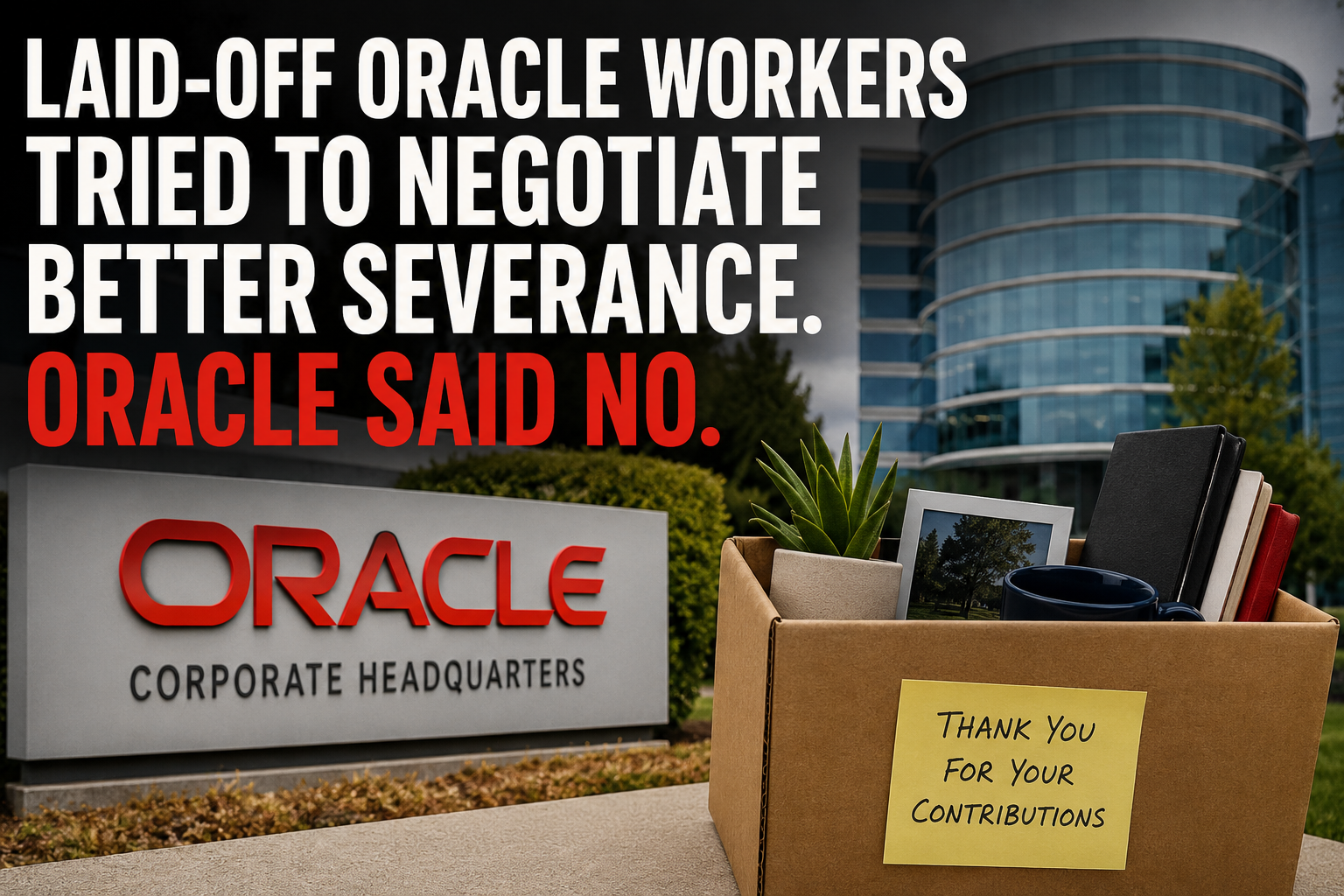
When layoffs hit a major tech company, employees often expect a standard severance package—and sometimes a little room for negotiation. But in the case of Oracle, recently laid-off workers discovered that flexibility wasn’t on the table.
According to accounts from affected employees, a group of workers who were part of a recent round of job cuts attempted to negotiate improved severance terms. Their requests included extended healthcare coverage, higher payout multiples based on tenure, and additional transition support. However, Oracle reportedly declined to adjust its initial offer, sticking firmly to its predefined severance policy.

A Structured but Rigid Severance Approach
Oracle’s severance packages are typically structured according to internal guidelines that factor in role level, tenure, and regional labor laws. In this case, employees were offered a standardized package that included a fixed number of weeks of pay, continuation of certain benefits for a limited period, and outplacement assistance.
While these terms are considered competitive within parts of the tech industry, some employees argued that the scale and timing of the layoffs—amid strong financial performance in certain business units—warranted more generous compensation.
Despite those appeals, the company maintained that consistency across layoffs was necessary to ensure fairness and operational clarity.
Employee Pushback and Frustration
The decision not to negotiate sparked frustration among several affected workers. Some felt that long-term employees, especially those who had contributed through multiple product cycles and restructuring phases, deserved more individualized consideration.
Others pointed out that the tech sector has seen a wide range of severance responses in recent years. Companies like Meta, Google, and Microsoft have at times offered enhanced packages, especially during large-scale layoffs, leading to expectations that similar flexibility might apply elsewhere.
However, Oracle’s stance highlights a contrasting approach: predictability over negotiation.
Broader Context: Tech Layoffs and Severance Trends
The broader technology industry has been navigating repeated waves of layoffs since the post-pandemic hiring boom cooled. As companies recalibrate hiring and investment strategies, severance policies have become a key point of employee concern.
In many firms, severance packages are not legally required beyond minimum labor protections, but are instead shaped by corporate policy and market competition for talent. This has created wide variation across companies—even within the same sector.
Oracle’s decision to hold firm on its standard package reflects a growing trend among some large enterprises to centralize and standardize exit terms, reducing case-by-case negotiation.
Legal and Strategic Considerations
From a corporate perspective, consistent severance policies can reduce legal risk. Allowing individual negotiations during layoffs may create perceptions of unequal treatment, potentially leading to disputes or claims of favoritism.
At the same time, critics argue that overly rigid policies can damage employer reputation and employee morale, particularly in industries where talent retention and brand perception are critical.
For laid-off employees, however, the lack of flexibility can feel impersonal—especially when transitions are abrupt and alternative job opportunities are uncertain.
Looking Ahead
As the tech sector continues to adjust to shifting economic conditions, severance practices are likely to remain under scrutiny. Workers are increasingly aware of differences between companies, and those differences can influence both career decisions and public perception.
For Oracle, the recent layoffs and the refusal to renegotiate severance terms underscore a deliberate emphasis on policy consistency. For employees, it serves as another reminder that even in high-profile tech companies, exit terms are rarely open to negotiation once formal policies are set.