Self-driving cars are no longer just a futuristic idea—they are already being tested and used in many parts of the world. At the heart of this revolution is Artificial Intelligence (AI), which helps vehicles “see,” “think,” and “react” like a human driver.
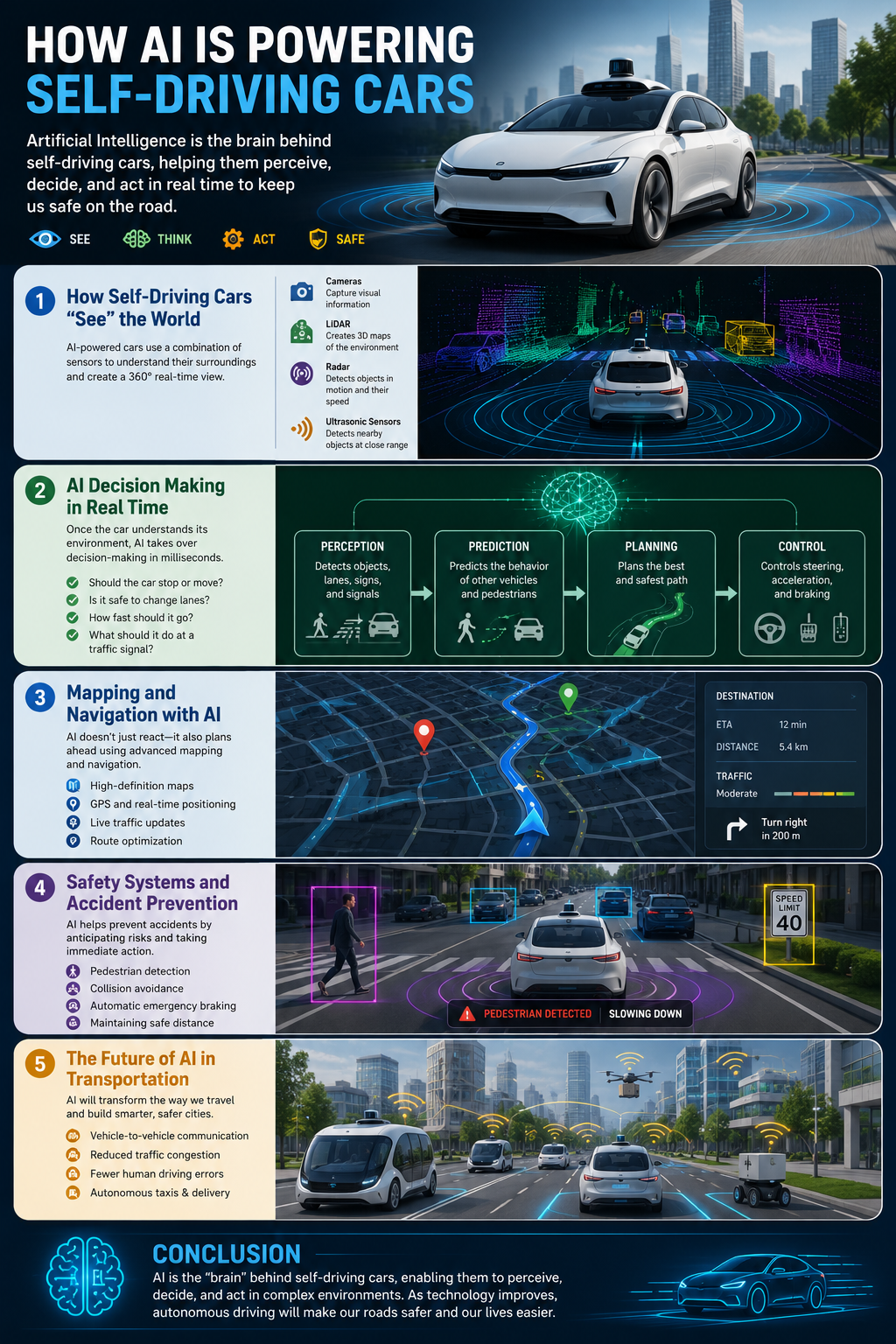
1. How Self-Driving Cars “See” the World 👁️
AI-powered cars use a combination of sensors to understand their surroundings:
- Cameras for visual input
- LiDAR for 3D mapping
- Radar for detecting objects in motion
- Ultrasonic sensors for close-range detection
These inputs are processed by AI systems to build a real-time map of the environment.


8
2. AI Decision Making in Real Time 🧠
Once the car understands its environment, AI takes over decision-making:
- Should the car stop or move?
- Is it safe to change lanes?
- How fast should it go?
- What should it do at a traffic signal?
Machine learning models trained on millions of driving hours help the system make safe and fast decisions.


7
3. Mapping and Navigation with AI 🗺️
AI doesn’t just react—it also plans ahead using:
- High-definition maps
- GPS data
- Real-time traffic updates
- Route optimization algorithms
This allows self-driving cars to choose the safest and fastest routes while avoiding traffic and obstacles.


7
4. Safety Systems and Accident Prevention 🛑
One of the biggest goals of AI in self-driving cars is improving safety:
- Detecting pedestrians instantly
- Predicting sudden vehicle movements
- Automatic emergency braking
- Maintaining safe distance from other vehicles
AI systems are constantly learning from real-world driving data to reduce accidents.


8
5. The Future of AI in Transportation 🚀
In the future, AI-powered vehicles may:
- Communicate with each other (vehicle-to-vehicle communication)
- Reduce traffic congestion
- Eliminate most human driving errors
- Enable fully autonomous taxis and delivery systems
Self-driving technology is still evolving, but AI is rapidly pushing it closer to everyday reality.


8
Conclusion
AI is the “brain” behind self-driving cars, enabling them to perceive, decide, and act in complex environments. As technology improves, autonomous driving is expected to become safer, more reliable, and widely accessible—changing the way we travel forever.