Why the AI Industry Is Moving Beyond the Simple Idea That Bigger Models Are Always Better
Artificial intelligence has spent much of the past decade chasing scale.
Larger datasets.
More parameters.
More computing power.
Bigger training clusters.
More sophisticated models.
The results have been remarkable. Giant AI models can write, reason, analyze images, generate software, summarize complex information, and perform increasingly sophisticated tasks.
But another trend is developing at the same time.
Small AI models are becoming increasingly capable. 📱⚡
Models that are small enough to run on laptops, smartphones, edge devices, private servers, and specialized hardware are becoming more useful for real-world applications.
This creates an important question:
Will the future of AI belong to giant models, small models, or a combination of both?
The answer is increasingly pointing toward specialization and cooperation rather than a single winner.
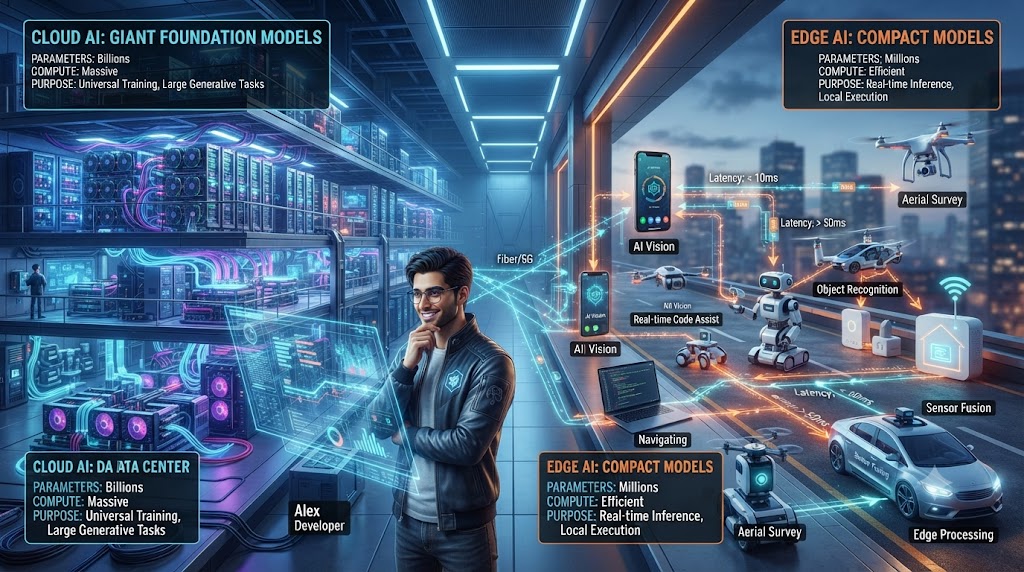
Large models are likely to remain important for highly complex reasoning and broad capabilities. Smaller models can offer speed, privacy, lower costs, offline operation, and efficient deployment.
The next generation of AI may therefore be built around an ecosystem in which giant models and small models work together.


🧠 What Is a Small AI Model?
A small AI model is an AI system designed with significantly fewer parameters and computational requirements than the largest frontier models.
The exact definition of “small” changes quickly because AI technology is advancing so rapidly.
A model considered large today could eventually be considered relatively modest.
Small models are attractive because they can often be deployed closer to the user.
Instead of sending every request to a massive cloud data center, an application can potentially process some tasks directly on:
📱 Smartphones
💻 Laptops
🖥️ Desktop computers
🚗 Vehicles
🏭 Industrial machines
📡 Edge devices
🏠 Smart-home hardware
This is known as edge AI or on-device AI, depending on the implementation.
The major advantage is that intelligence can move closer to where the data is generated.
🌌 What Is a Giant AI Model?
Giant AI models are highly capable systems trained using enormous datasets and substantial computational resources.
They are designed to handle a broad range of tasks.
A frontier model may be capable of:
📝 Writing
💻 Coding
🧮 Mathematical reasoning
🔎 Research
🖼️ Image understanding
🎙️ Audio processing
🎥 Video understanding
🌐 Multilingual communication
🧠 Complex problem solving
These capabilities come from massive training processes, sophisticated architectures, large-scale datasets, and significant computing infrastructure.
The biggest models can act as general-purpose AI systems rather than narrow tools.
But there is a trade-off.
Large models can require substantial computing resources to train and operate.
⚔️ Small vs. Giant: The Fundamental Difference
The simplest comparison looks like this:
| Feature | Small AI Models | Giant AI Models |
|---|---|---|
| Computing needs | Lower | Very high |
| Deployment | Often easier | Usually infrastructure-heavy |
| Cost per task | Potentially lower | Potentially higher |
| Speed | Often very fast | Can vary |
| Offline use | More practical | Usually difficult |
| Privacy | Strong potential for local processing | Often cloud-dependent |
| General capability | More limited | Broader |
| Specialization | Excellent | Broad |
| Complex reasoning | More limited | Generally stronger |
| Edge deployment | Highly suitable | More difficult |
But this table hides an important reality.
Model size is not the only factor determining capability.
Architecture, training data, post-training, inference methods, tool use, reasoning strategies, and specialization can all matter.
⚡ Why Small AI Models Are Becoming More Important
The rise of small models is not simply because companies want cheaper AI.
There are several powerful reasons.
📱 1. AI Is Moving Onto Devices
Smartphones are becoming increasingly capable AI platforms.
Instead of sending every request to the cloud, certain tasks can potentially be processed directly on the device.
This can make applications faster and reduce dependence on network connectivity.
For example, an on-device model could help with:
🎤 Voice commands
📷 Image classification
⌨️ Text prediction
🌐 Translation
📄 Document summarization
🔎 Personal search
These applications do not always require the most powerful AI model available.
A compact specialized model may be sufficient.
🔒 2. Privacy Can Improve
One major advantage of local AI is that sensitive information can potentially remain on the device.
Imagine an AI that analyzes your personal notes.
With a cloud-only system, information may need to be transmitted to remote servers depending on the product’s architecture and privacy settings.
With local processing, the data can potentially remain on your device.
This does not automatically make a system completely private or secure, but local processing can reduce some forms of data transmission.
For applications involving:
🔐 Personal documents
📷 Photos
🎙️ Voice recordings
🏢 Confidential business information
that can be particularly valuable.
💰 3. Lower Inference Costs
Operating giant models can require substantial computing infrastructure.
Every AI request consumes computing resources.
When millions of people use an AI service, those costs become significant.
Smaller models generally require fewer resources.
This can make them attractive for applications where millions of routine AI interactions occur.
For example, a company may not need a frontier-scale model to classify customer messages into ten categories.
A small specialized model might perform the task efficiently.
🚀 4. Speed
Smaller models can potentially respond very quickly.
This matters for applications where delays are noticeable.
Consider:
🎮 Games
🚗 Vehicles
🏭 Industrial robotics
📱 Mobile assistants
🕶️ Augmented reality
🏠 Smart-home systems
If an AI system must respond immediately, relying on a distant cloud server can introduce latency.
Local inference can reduce that delay.
🌐 The Rise of Edge AI
Edge AI means processing AI workloads closer to where data is produced rather than sending everything to centralized cloud infrastructure.
This is becoming increasingly important as billions of devices generate data.
A smart camera can analyze an image locally.
A vehicle can process sensor information locally.
A factory machine can detect unusual behavior locally.
A smartphone can perform speech recognition locally.
The cloud can still provide additional capabilities when necessary.
This creates a distributed AI architecture.


🧩 Small Models Are Excellent at Specialized Tasks
One of the biggest misunderstandings about small AI models is that they must compete directly with giant general-purpose models.
They don’t always need to.
A small model designed specifically for one task can be extremely useful.
Imagine a manufacturing company that needs to detect defects in products.
It might not need a massive general-purpose language model.
Instead, it could deploy a specialized vision model trained to identify specific defects.
Similarly, a customer-service company could use a small classification model to route incoming requests.
A hospital might use specialized models for particular image-analysis workflows under appropriate professional oversight.
The future of AI could therefore involve many specialized models rather than one universal model doing everything.
🧠 Where Giant AI Models Still Have an Advantage
Despite the rise of small models, giant models remain extremely important.
Their biggest advantage is breadth.
A powerful general-purpose model can perform many different tasks without being separately trained for every one.
It can potentially switch from:
Writing an article
to analyzing code
to explaining mathematics
to interpreting an image
to summarizing research
to planning a workflow.
That flexibility is difficult for highly specialized small models to reproduce.
Large models are particularly valuable when the problem is unpredictable and requires broader reasoning.
🔬 Complex Reasoning Favors Larger Systems
Some tasks require understanding multiple pieces of information simultaneously.
For example:
“Analyze this business problem, compare several possible strategies, identify risks, calculate the financial implications, and prepare an implementation plan.”
A small specialized model may struggle with such a broad assignment.
A powerful general-purpose model may be much better suited.
This is one reason frontier-scale AI remains important for research, advanced software development, complex analysis, and other demanding tasks.
🌍 Giant Models Can Become AI Platforms
Another advantage of large models is that they can serve as platforms.
Developers can build applications on top of them.
A company does not necessarily need to train its own enormous model.
Instead, it can use a large foundation model through an API and create a specialized application around it.
This means giant models can become infrastructure for an entire ecosystem of applications.
Small models, meanwhile, can handle specialized tasks closer to users.
This creates a natural division of labor.
🤝 The Future May Be a Hybrid AI Architecture
Instead of asking:
“Small models or giant models?”
a more useful question may be:
“Which model should handle which task?”
Imagine your smartphone assistant.
You ask:
“Set an alarm for 6:30 tomorrow.”
A small on-device model can understand the simple command.
No massive model may be necessary.
Then you ask:
“Analyze my last six months of spending and explain the biggest changes.”
The system could route the task to a more capable cloud model or specialized financial analysis system.
The architecture becomes:
Small model → simple task
Large model → complex task
Specialized model → domain-specific task
This could become one of the defining patterns of future AI systems.
🔀 AI Model Routing Could Become Essential
As organizations deploy many AI models, another technology becomes important: model routing.
A routing system decides which AI model should process a request.
For example:
🟢 Simple question → Small model
🟡 Moderate task → Medium model
🔴 Complex reasoning → Frontier model
This approach can potentially reduce costs while maintaining quality.
A company does not need to use its most expensive model for every request.
Instead, the system dynamically chooses the appropriate model.
This could make large-scale AI deployments more economical.
🏢 Businesses May Use Model Portfolios
Companies could eventually maintain a portfolio of AI models.
For example:
Customer Support
Small language model
Fraud Detection
Specialized machine-learning model
Document Processing
Medium-sized multimodal model
Complex Research
Large frontier model
Factory Inspection
Computer-vision model
Personal Assistant
Hybrid local + cloud architecture
This resembles how companies already use different software tools for different departments.
AI may become a portfolio rather than a single product.
📱 Small AI Models and Smartphones
Smartphones are likely to become an important battlefield for small AI.
Modern phones already contain specialized AI hardware designed to accelerate machine-learning workloads.
As models become more efficient, more capabilities can move directly onto devices.
Imagine a smartphone that can:
📷 Understand photographs
🎤 Translate conversations
📝 Summarize messages
📄 Search documents
🧠 Organize personal information
🔎 Search local content
🎧 Process audio
without sending every request to a remote data center.
This could make smartphones significantly more intelligent.
🚗 Small AI Models in Vehicles
Vehicles are another major application.
Cars generate enormous amounts of sensor information.
Cameras, radar, microphones, navigation systems, and other sensors continuously produce data.
A vehicle cannot necessarily send every piece of information to a distant server and wait for a response.
Some decisions need to happen locally.
Small and specialized AI models can therefore be useful for:
🚘 Driver assistance
📷 Object detection
🛣️ Road analysis
⚠️ Hazard detection
🎙️ Voice control
🔧 Predictive maintenance
Local processing can reduce latency and improve resilience when connectivity is unavailable.
🏭 Small AI Models in Industry
Factories may become another major area for compact AI.
Industrial equipment can use specialized models to identify abnormal behavior.
For example, a model could analyze vibration patterns and detect early signs of equipment problems.
Another model could inspect products for defects.
Another could monitor energy consumption.
These systems don’t need broad conversational intelligence.
They need reliable performance on specific tasks.
That makes small specialized models particularly attractive.
🧪 Small Models Could Democratize AI
Training and operating giant AI systems requires substantial resources.
Only a relatively small number of organizations can build frontier-scale models from scratch.
Small models are different.
Researchers, startups, universities, developers, and businesses can often experiment with smaller systems using much more accessible infrastructure.
This can encourage innovation.
Developers can customize models for:
Education
Healthcare
Agriculture
Finance
Manufacturing
Languages
Scientific research
Local applications
Small models can therefore make AI more accessible to organizations that cannot afford massive computing infrastructure.
🌍 Local Language AI
Small models may also become important for languages and communities that receive less attention from the largest AI systems.
A specialized model can be optimized for particular languages, dialects, industries, or cultural contexts.
For example, a compact model could be designed for a specific regional language and deployed on low-cost devices.
This could expand access to AI.
Instead of requiring everyone to use the same global AI system, communities could develop models adapted to their own needs.
🧠 Distillation: Making Big AI Smaller
One important technique behind the small-model revolution is knowledge distillation.
The basic idea is that a smaller model can learn from a larger model.
A large teacher model generates useful training signals.
A smaller student model learns to reproduce important capabilities.
The result can be a compact model that retains some of the larger model’s useful behavior while requiring fewer resources.
Distillation is not magic.
A smaller model will generally have limitations compared with the system that taught it.
But it can make AI capabilities more practical for deployment.
⚙️ Quantization and Efficient AI
Another important technique is quantization.
AI models normally use numerical representations that can require significant memory.
Quantization reduces the precision used to represent model parameters.
This can significantly reduce memory requirements and make inference more efficient.
Combined with:
- Distillation
- Pruning
- Better architectures
- Specialized hardware
- Efficient inference software
these techniques can make sophisticated AI models increasingly practical on consumer and edge devices.
🔋 The Energy Question
AI requires electricity.
Large models can consume substantial computational resources during training and inference.
Smaller models can potentially reduce the computing required for many workloads.
This does not mean small AI is automatically environmentally harmless.
Billions of small AI devices can collectively consume significant energy.
But efficient models can help organizations perform useful AI tasks without always requiring the computational resources of a giant model.
Energy efficiency is therefore likely to become an increasingly important model-design criterion.
🔐 Small Models and Data Sovereignty
Another major benefit of local AI is control over data.
Organizations handling sensitive information may prefer processing data locally or within controlled infrastructure.
For example:
🏥 Healthcare organizations
🏦 Financial institutions
🏢 Enterprises
🏛️ Government organizations
🔬 Research institutions
may have reasons to limit external data transmission.
A capable local model could help organizations maintain greater control over sensitive information.
However, local deployment still requires strong cybersecurity.
An AI model running on a device is not automatically secure.
⚠️ Are Small Models Always Better?
No.
Small models have limitations.
They may struggle with complex reasoning, unusual questions, broad knowledge, or long multi-step tasks.
A model optimized for one task may perform poorly outside its intended environment.
Large models can also be easier to use when developers need a single system capable of handling many different tasks.
Therefore, choosing a model should depend on the application.
A useful question is:
What level of intelligence does this task actually require?
⚠️ Are Giant Models Always Better?
Not necessarily.
A giant model may be unnecessary for simple tasks.
Using an extremely powerful model to classify a basic support request could be inefficient.
If a small model can perform the task accurately, the larger model may provide little additional value.
This is similar to computing in general.
You do not need a supercomputer to write a text message.
You need the appropriate tool for the job.
🌐 The Future May Be a Network of Models
One of the most exciting possibilities is that future AI systems may consist of multiple models working together.
Imagine:
📱 A small model on your phone
☁️ A large model in the cloud
🏭 A specialized industrial model
🔎 A retrieval system
🧮 A mathematical reasoning model
👁️ A vision model
A central AI system could determine which model should handle each task.
The result is not one giant AI.
It is an AI ecosystem.
This concept connects closely with the broader movement toward AI agents and autonomous digital networks.
🤖 Small Models Could Power AI Agents
AI agents do not always need the largest possible model.
An agent performing a routine task may benefit from a compact model because it needs to operate frequently and cheaply.
Imagine a digital workplace containing:
🤖 Scheduling Agent
🤖 Email Agent
🤖 Research Agent
🤖 Data Agent
🤖 Security Agent
Each agent could use a different model depending on its requirements.
A simple scheduling agent might use a small local model.
A research agent could use a much larger model.
A security agent might use a specialized detection model.
This could make autonomous AI systems more efficient.
📈 The AI Industry Is Moving Toward Efficiency
The early AI race focused heavily on scale.
The next phase is increasingly about efficiency per unit of intelligence.
Companies and researchers are looking at questions such as:
How much computing is required?
How quickly can the model respond?
How much memory does it need?
Can it run locally?
How much does each request cost?
How accurate is it for a particular task?
Can it operate without constant cloud connectivity?
These questions are becoming as important as raw benchmark performance.
🔮 What Will AI Look Like in 2030?
It is difficult to predict exactly which models will dominate.
But a plausible future involves multiple levels of AI.
📱 On-device AI
Handles personal, routine, low-latency tasks.
🖥️ Local AI
Handles more demanding workloads on personal computers and enterprise servers.
☁️ Cloud AI
Handles complex reasoning and resource-intensive tasks.
🧩 Specialized AI
Handles specific industries and functions.
🤖 Agentic AI
Coordinates multiple models and tools to accomplish broader goals.
This layered architecture could be more practical than relying on a single model for everything.
🧭 So, Which Direction Is the Future Taking?
The evidence from current AI development points toward both smaller and larger models rather than an exclusive choice between them.
Giant models will remain important because they provide broad capabilities and increasingly sophisticated reasoning.
Small models will become more important because they offer efficiency, speed, privacy, specialization, and local deployment.
The biggest opportunity may lie in combining them.
A future AI system could automatically determine:
“This task is simple. I’ll handle it locally.”
Then:
“This task requires deeper reasoning. I’ll send it to a larger model.”
And finally:
“This is a specialized problem. I’ll call the appropriate expert model.”
That is a fundamentally different vision of AI.
🌟 Conclusion: The Future Is Probably Hybrid
The debate between small AI models and giant AI models can sound like a competition.
But the technology is increasingly suggesting a different possibility.
They may become complementary. 🤝
Giant models can provide broad intelligence, advanced reasoning, multimodal capabilities, and general-purpose problem solving.
Small models can bring AI to phones, vehicles, factories, laptops, private servers, and specialized applications.
Together, they can create a more distributed AI ecosystem.
The future may therefore not be dominated by one enormous model.
Instead, we may see millions of smaller AI systems working alongside powerful cloud models, with intelligent routing determining which model handles each task.
The biggest AI breakthrough may ultimately be not making one model infinitely large, but creating systems that know when to use a small model, when to call a giant model, and how to combine many specialized models into one intelligent experience. 🧠⚡🌐