Discover quantum computing in simple terms with this beginner-friendly guide. Learn about qubits, superposition, entanglement, quantum algorithms, real-world applications, challenges, and the future of quantum technology.
Table of Contents
- Introduction
- What Is Quantum Computing?
- Why Quantum Computing Matters
- Classical Computing vs. Quantum Computing
- Understanding Bits and Qubits
- The Science Behind Quantum Computing
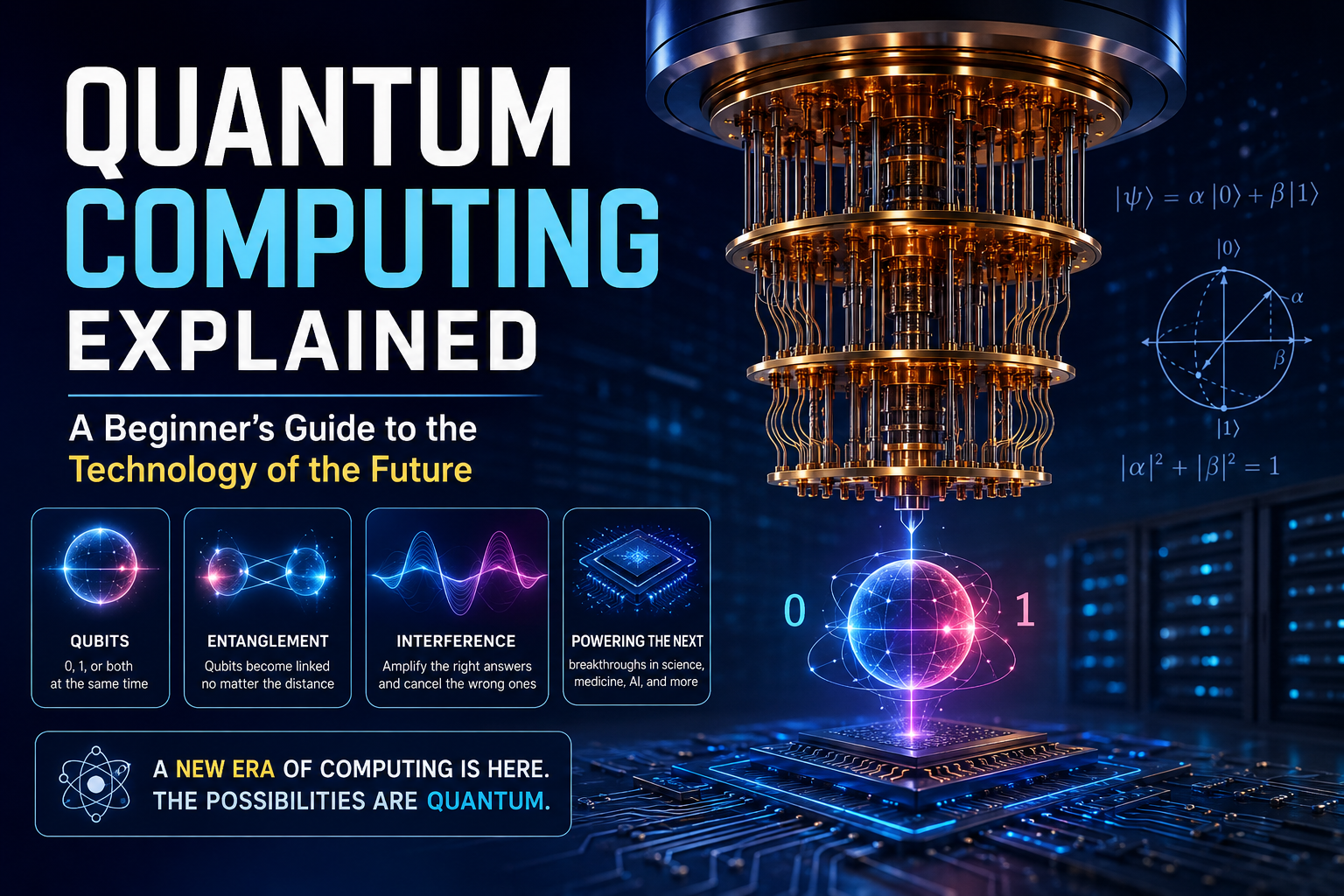
- Superposition Explained
- Entanglement Explained
- Quantum Interference
- Conclusion (Part 1)
Introduction 🌍
Technology has transformed the way we live, work, and communicate. From smartphones and cloud computing to artificial intelligence, each technological breakthrough has changed industries and everyday life. Today, another revolutionary technology is beginning to emerge—quantum computing.
Although the term may sound complex, the basic idea behind quantum computing can be understood without an advanced background in physics. Unlike traditional computers that process information one step at a time using binary digits, quantum computers harness the unusual principles of quantum mechanics to solve certain problems much more efficiently.
Researchers believe quantum computing could revolutionize medicine, cybersecurity, finance, logistics, artificial intelligence, and scientific research. While practical quantum computers are still being developed, governments, universities, and technology companies around the world are investing billions of dollars to unlock their potential.
This beginner-friendly guide explains quantum computing in simple language, making it easy to understand how it works, why it matters, and what the future may hold.
What Is Quantum Computing? ⚛️
Quantum computing is a new approach to computing that uses the principles of quantum mechanics—the branch of physics that studies the behavior of extremely small particles such as electrons and photons.
Traditional computers use bits to store and process information. Every bit can hold only one value at a time:
- 0
- 1
Quantum computers, however, use quantum bits, commonly called qubits.
Unlike ordinary bits, qubits can exist in multiple states simultaneously because of quantum mechanical effects. This allows quantum computers to perform certain calculations in a fundamentally different way.
Instead of checking one possible solution after another, quantum computers can explore many possibilities simultaneously for specific types of problems.
This doesn’t mean quantum computers are better at everything. Rather, they excel in solving highly complex mathematical and scientific problems that would take classical computers an impractically long time.
Why Quantum Computing Matters 💡
As the world generates enormous amounts of data every second, some computational problems become increasingly difficult for classical computers.
Examples include:
- Predicting molecular interactions for new medicines
- Optimizing global transportation routes
- Designing advanced materials
- Breaking down complex financial models
- Simulating quantum systems
- Improving artificial intelligence algorithms
Some of these calculations could take traditional supercomputers years—or even longer—to complete.
Quantum computers have the potential to reduce these times dramatically for suitable problems.
This capability could accelerate scientific discoveries and improve decision-making across many industries.
Classical Computing vs Quantum Computing 🖥️
To appreciate quantum computing, it’s important to understand how today’s computers operate.
Every laptop, smartphone, gaming console, and desktop computer relies on classical computing.
These machines process information using billions of tiny electrical switches called transistors.
Each transistor represents either:
- ON (1)
- OFF (0)
These binary values form the foundation of all digital technology.
Whether you’re watching videos, browsing websites, editing documents, or playing games, everything is ultimately represented by combinations of zeros and ones.
Quantum computers use an entirely different method.
Instead of simple binary switches, they manipulate quantum states that follow the laws of quantum mechanics.
This difference allows quantum computers to tackle some calculations much more efficiently.
Comparison Table
| Classical Computer | Quantum Computer |
|---|---|
| Uses bits | Uses qubits |
| Binary values only | Multiple quantum states |
| Sequential calculations | Parallel exploration of possibilities for certain algorithms |
| Reliable for everyday computing | Specialized for complex computational problems |
| Used in homes and offices | Primarily used in research and advanced industries |
Understanding Bits and Qubits 🔢
The biggest difference between classical and quantum computing lies in how information is stored.
What Is a Bit?
A bit is the smallest unit of digital information.
It can only be:
- 0
- 1
Imagine a light switch.
The switch can either be:
- OFF
- ON
Nothing exists in between.
Computers use billions of these tiny switches every second.
What Is a Qubit?
A qubit behaves very differently.
Instead of existing only as 0 or 1, it can exist in a combination of both states until it is measured.
This unique property enables quantum computers to process information in ways impossible for classical machines.
Qubits can be created using different physical systems, including:
- Superconducting circuits
- Trapped ions
- Photons
- Neutral atoms
- Quantum dots
Different companies and research labs are exploring these approaches to determine which can scale most effectively.
The Science Behind Quantum Computing 🔬
Quantum computing is based on the fascinating laws of quantum mechanics.
Unlike everyday objects, tiny particles behave in ways that often seem strange or even counterintuitive.
Scientists discovered that particles such as electrons don’t always behave like tiny solid balls.
Sometimes they behave like waves.
Sometimes they behave like particles.
These unusual behaviors enable quantum computers to perform computations differently.
Three major quantum principles power these machines:
- Superposition
- Entanglement
- Quantum interference
Let’s understand each one.
Superposition Explained 🌊
Superposition is perhaps the most famous concept in quantum computing.
In classical computing:
A bit is either:
- 0
- 1
A qubit, however, can represent both possibilities simultaneously until it is measured.
Imagine spinning a coin.
While spinning, you cannot clearly say it is heads or tails.
Only when it lands do you observe one definite result.
Although this analogy isn’t perfect, it helps visualize the idea that a qubit can represent multiple possibilities before measurement.
Because multiple qubits can exist in superposition together, quantum computers can represent an enormous number of possible combinations.
This property is one reason quantum algorithms can outperform classical ones for certain tasks.
Entanglement Explained 🔗
Entanglement is another remarkable feature of quantum mechanics.
When two qubits become entangled, they share a special relationship.
The state of one qubit becomes linked to the state of the other, even if they are physically separated.
This connection allows quantum computers to coordinate information efficiently during calculations.
Entanglement is one of the key resources that gives quantum algorithms their computational power.
Scientists continue to study entanglement because it also has applications in:
- Quantum communication
- Quantum cryptography
- Quantum networking
- Quantum teleportation experiments
Although these ideas sound like science fiction, they are active areas of scientific research.
Quantum Interference 🌈
Quantum interference helps quantum computers guide calculations toward the correct answer.
Think of waves in water.
When two waves meet, they may combine to create larger waves or cancel each other out.
Quantum algorithms use a similar principle.
Desired solutions are strengthened while incorrect possibilities are weakened.
This improves the probability of measuring the correct result after computation.
Without interference, quantum computers would lose much of their computational advantage.
Quantum computing introduces a fundamentally new way of processing information. By replacing traditional bits with qubits and leveraging principles such as superposition, entanglement, and quantum interference, it opens the door to solving problems that are beyond the practical reach of many classical computers. While the technology is still developing, understanding these core concepts provides a strong foundation for exploring its future applications.
How Quantum Computers Work, Applications, and Advantages
Welcome to Part 2 of this beginner-friendly guide to quantum computing. In Part 1, we explored the basics of quantum computing, including qubits, superposition, entanglement, and quantum interference. Now, let’s dive deeper into how quantum computers actually work, the different types of quantum hardware, their real-world applications, and why this technology is attracting global attention.
How Do Quantum Computers Work? ⚙️
Unlike classical computers that use electrical circuits to process binary data, quantum computers manipulate qubits using quantum operations.
A quantum computer consists of several key components that work together:
- Qubits
- Quantum gates
- Quantum circuits
- Control electronics
- Measurement systems
Instead of performing calculations by simply switching transistors on and off, quantum computers carefully manipulate the quantum states of qubits.
The general workflow is:
Step 1: Initialize the Qubits
The computer prepares qubits in a known quantum state.
Step 2: Apply Quantum Gates
Quantum gates change the probability of different quantum states.
Unlike classical logic gates (AND, OR, NOT), quantum gates perform mathematical transformations using quantum mechanics.
Step 3: Build a Quantum Circuit
A sequence of quantum gates forms a quantum circuit.
Each circuit is designed to solve a specific computational problem.
Step 4: Measure the Qubits
At the end of computation, the qubits are measured.
Measurement converts the quantum information into classical bits that humans can interpret.
What Are Quantum Gates? 🚪
Quantum gates are the building blocks of quantum algorithms.
Just as classical computers use logic gates, quantum computers use quantum gates to manipulate qubits.
Some common quantum gates include:
Pauli-X Gate
Similar to a NOT gate.
Changes:
0 → 1
1 → 0
Hadamard Gate
One of the most important quantum gates.
It places a qubit into superposition, allowing it to represent multiple possibilities simultaneously.
CNOT Gate
The Controlled-NOT (CNOT) gate creates entanglement between qubits.
Many powerful quantum algorithms depend on this operation.
Phase Gates
These gates adjust the quantum phase of qubits, helping algorithms produce the correct interference patterns.
Quantum Circuits Explained 🔄
A quantum circuit is a sequence of quantum gates applied to qubits.
Think of it like a recipe.
Instead of combining ingredients, you combine quantum operations to solve a problem.
Different algorithms require different circuits.
Some famous quantum algorithms include:
- Shor’s Algorithm
- Grover’s Algorithm
- Quantum Fourier Transform
- Variational Quantum Eigensolver (VQE)
- Quantum Approximate Optimization Algorithm (QAOA)
These algorithms are designed for tasks such as factoring large numbers, searching databases, optimization, and simulating molecules.
Types of Quantum Computers 🖥️
Researchers are exploring several approaches to building quantum computers.
Each has its own strengths and challenges.
1. Superconducting Quantum Computers
These use superconducting electrical circuits cooled to extremely low temperatures.
Advantages:
- Fast gate operations
- Well-developed technology
- Widely used by leading technology companies
Challenges:
- Require expensive cryogenic cooling
- Sensitive to noise
2. Trapped Ion Quantum Computers
These use electrically charged atoms (ions) suspended by electromagnetic fields.
Advantages:
- High accuracy
- Stable qubits
- Long coherence times
Challenges:
- Slower operations compared to superconducting systems
3. Photonic Quantum Computers
These use particles of light (photons) to perform quantum computations.
Advantages:
- Operate at or near room temperature
- Suitable for quantum communication
Challenges:
- Difficult to scale efficiently
4. Neutral Atom Quantum Computers
These manipulate individual neutral atoms using laser technology.
Advantages:
- Highly scalable
- Promising for future large-scale systems
Challenges:
- Technology is still under active development
5. Quantum Annealers
Quantum annealers specialize in optimization problems rather than general-purpose quantum computing.
They are useful for solving certain complex scheduling and resource allocation tasks.
Real-World Applications of Quantum Computing 🌍
Although quantum computing is still developing, researchers have already identified many promising applications.
1. Drug Discovery 💊
Developing new medicines often requires simulating how molecules interact.
Classical computers struggle with these complex calculations.
Quantum computers could:
- Design new drugs faster
- Improve vaccines
- Discover treatments for rare diseases
- Reduce research costs
2. Artificial Intelligence 🤖
Machine learning models continue growing larger and more complex.
Quantum computing may help:
- Train AI models faster
- Improve optimization
- Speed up pattern recognition
- Solve complex mathematical problems
Researchers are actively exploring the emerging field of Quantum Machine Learning (QML).
3. Financial Services 💰
Banks analyze enormous amounts of financial data every second.
Quantum computing could improve:
- Portfolio optimization
- Risk analysis
- Fraud detection
- Investment strategies
- Market simulations
4. Cybersecurity 🔒
Quantum computing presents both opportunities and challenges for cybersecurity.
Benefits
- Stronger encryption methods
- Quantum key distribution
- Secure communications
Challenges
Powerful quantum computers may eventually break some of today’s widely used encryption systems, driving the development of post-quantum cryptography to protect future digital communications.
5. Logistics and Transportation 🚚
Large delivery companies solve millions of routing decisions daily.
Quantum optimization could improve:
- Airline scheduling
- Shipping routes
- Warehouse management
- Supply chain efficiency
- Traffic management
This can reduce fuel consumption and operating costs.
6. Climate Science 🌱
Climate models require immense computational power.
Quantum computing may help scientists:
- Predict weather more accurately
- Simulate ocean currents
- Model carbon capture technologies
- Develop cleaner energy systems
7. Materials Science 🧪
Scientists are searching for stronger, lighter, and more efficient materials.
Quantum simulations could help design:
- Better batteries
- Advanced semiconductors
- Stronger alloys
- Efficient solar panels
- New superconductors
Advantages of Quantum Computing ⭐
Quantum computing offers several potential benefits over classical computing for specific types of problems.
Faster Problem Solving
Certain algorithms can be executed much more efficiently than on traditional computers.
Better Optimization
Quantum computers excel at finding optimal solutions among many possibilities.
Accurate Molecular Simulation
They can model molecular interactions with greater precision, supporting advances in chemistry and medicine.
Improved Artificial Intelligence
Quantum-enhanced algorithms may accelerate AI research and enable new approaches to machine learning.
Scientific Discovery
Quantum computing could accelerate breakthroughs in physics, biology, chemistry, and engineering by enabling simulations that are currently beyond the reach of classical systems.
Industries Expected to Benefit 📈
As quantum technology matures, it is expected to impact a wide range of industries, including:
- Healthcare
- Pharmaceuticals
- Banking and Finance
- Manufacturing
- Automotive
- Aerospace
- Telecommunications
- Energy
- Government Research
- Artificial Intelligence
- Cybersecurity
- Agriculture
- Environmental Science
Organizations in these sectors are already investing in quantum research to prepare for future advancements
Quantum computers work very differently from classical computers, using qubits, quantum gates, and specialized circuits to process information in unique ways. Although the technology is still evolving, its potential applications span healthcare, finance, logistics, cybersecurity, AI, climate science, and more. As researchers continue improving hardware and software, quantum computing is expected to become an increasingly valuable tool for solving some of the world’s most challenging computational problems.
Current Challenges of Quantum Computing ⚠️
Despite its incredible potential, quantum computing is still in its early stages. Scientists and engineers face several technical obstacles before quantum computers can become widely available
1. Quantum Decoherence
One of the biggest challenges is decoherence.
Qubits are extremel delicate. Even tiny disturbances from heat, vibrations, or electromagnetic radiation can cause them to lose their quantum state.
When this happens, calculations become unreliable.
Researchers are developing better hardware and error-correction methods to keep qubits stable for longer periods.
2. High Error Rates
Unlike classical computers, quantum computers are naturally prone to errors.
Each quantum operation has a small chance of failing.
As calculations become more complex, these small errors can accumulate and affect the final result.
To address this, researchers are developing quantum error correction, which uses multiple physical qubits to create a more reliable logical qubit.
3. Extreme Cooling Requirements ❄️
Many quantum computers operate at temperatures close to absolute zero (-273.15°C).
These ultra-low temperatures help reduce environmental noise and keep qubits stable.
Maintaining such conditions requires sophisticated refrigeration systems, making quantum computers expensive and difficult to operate.
4. Limited Number of Qubits
Today’s quantum computers contain far fewer reliable qubits than would be needed for many large-scale applications.
Researchers are working to increase the number of qubits while maintaining accuracy and stability.
Building larger, more reliable quantum systems remains one of the biggest engineering challenges.
5. High Development Costs
Developing quantum hardware requires advanced laboratories, specialized materials, and highly skilled researchers.
As a result, quantum computing remains a costly field, though ongoing research aims to make the technology more practical and affordable over time.
Quantum Computing vs Artificial Intelligence 🤖
Many people confuse quantum computing with artificial intelligence, but they are different technologies.
Artificial Intelligence
AI focuses on enabling computers to perform tasks that typically require human intelligence, such as:
- Image recognition
- Natural language processing
- Speech recognition
- Recommendation systems
- Predictive analytics
Quantum Computing
Quantum computing focuses on solving certain computational problems more efficiently using the principles of quantum mechanics.
Can They Work Together?
Yes.
Researchers are exploring Quantum Machine Learning (QML), where quantum computing may accelerate some machine learning algorithms and optimization tasks.
Rather than replacing AI, quantum computing is expected to complement it in specific areas.
Common Myths About Quantum Computing ❌
Myth 1: Quantum Computers Will Replace Your Laptop
Reality: Quantum computers are specialized machines designed for particular scientific and industrial tasks. Traditional computers will continue to handle everyday activities like browsing, gaming, programming, and office work.
Myth 2: Quantum Computers Are Faster at Everything
Reality: Quantum computers excel only for specific classes of problems. Many everyday computing tasks will still be better suited to classical computers.
Myth 3: Quantum Computing Is Just Science Fiction
Reality: Quantum computers already exist in research laboratories and are accessible through cloud-based platforms. While they are still evolving, they are very real.
Myth 4: Quantum Computers Can Instantly Solve Every Problem
Reality: Quantum computing is not a magic solution. Some problems will always be better handled by classical computers, while others may benefit significantly from quantum algorithms.
The Future of Quantum Computing 🌟
The future of quantum computing is promising, but practical large-scale systems will require continued advances in hardware, software, and error correction.
Some developments we may see over the next decade include:
Better Error Correction
More reliable qubits will enable longer and more complex quantum computations.
More Powerful Quantum Hardware
Researchers aim to build systems with thousands—or even millions—of stable logical qubits.
Quantum Internet
Scientists are exploring secure quantum communication networks that use quantum principles to transmit information with enhanced security.
New Medicines
Quantum simulations may significantly speed up the discovery of drugs and materials by modeling molecular interactions more accurately.
Sustainable Energy Solutions
Quantum computing could help optimize renewable energy systems, improve battery technology, and design more efficient materials.
Advanced Artificial Intelligence
Combining AI with quantum computing may enable breakthroughs in optimization, pattern recognition, and scientific modeling.
Career Opportunities in Quantum Computing 💼
As the field grows, demand for skilled professionals is expected to increase.
Some exciting career paths include:
- Quantum Software Developer
- Quantum Algorithm Researcher
- Quantum Hardware Engineer
- Quantum Physicist
- Machine Learning Researcher
- Cryptography Specialist
- Data Scientist
- Research Scientist
- Cloud Computing Engineer
- Systems Architect
Students interested in mathematics, computer science, engineering, or physics may find rewarding opportunities in this emerging field.
Frequently Asked Questions (FAQs) ❓
1. Is quantum computing difficult to learn?
The underlying physics can be complex, but beginners can understand the basic concepts with simple explanations and consistent study.
2. Will quantum computers replace traditional computers?
No. Quantum computers are expected to complement classical computers rather than replace them.
3. Can I learn quantum computing without studying physics?
Yes. Many introductory resources focus on the concepts before diving into advanced mathematics and quantum mechanics.
4. Are quantum computers available today?
Yes. Researchers and developers can access several quantum computing platforms through cloud services for experimentation and learning.
5. Which industries will benefit the most?
Healthcare, finance, logistics, cybersecurity, chemistry, materials science, artificial intelligence, and climate research are among the sectors expected to benefit.
6. Is quantum computing the future?
Quantum computing is expected to play an important role in solving specialized problems, but it will work alongside classical computing rather than replace it.
Final Thoughts 📝
Quantum computing represents one of the most exciting frontiers in modern science and technology. By leveraging qubits, superposition, entanglement, and quantum interference, quantum computers have the potential to solve certain complex problems far more efficiently than classical computers.
Although significant technical challenges remain—including error correction, scalability, and hardware stability—the rapid pace of research and investment suggests that quantum computing will become an increasingly valuable tool across many industries.
For beginners, understanding the foundational concepts is the first step toward appreciating how this transformative technology could reshape medicine, finance, artificial intelligence, cybersecurity, logistics, and scientific research in the years ahead. As quantum and classical computing continue to evolve together, the future promises a new era of innovation driven by the strengths of both technologies.