Generative AI is rapidly changing the way businesses, creators, designers, and marketers produce digital content. From writing articles and creating images to developing advertising campaigns and personalized customer experiences, artificial intelligence is becoming an important part of modern creative workflows.
Unlike traditional software that follows predefined instructions, generative AI can create new content based on prompts and available context. This capability is transforming creative work by helping people generate ideas faster, automate repetitive tasks, and experiment with different formats.
Generative AI and the Future of Content Creation
Content creation is one of the areas experiencing the most visible impact from generative AI. Writers and publishers can use AI tools to brainstorm topics, develop outlines, summarize information, create first drafts, and adapt content for different audiences.
For businesses operating multiple websites or social media channels, generative AI can also help create variations of headlines, descriptions, captions, newsletters, and other marketing materials. This can reduce the amount of time spent on repetitive writing tasks.
However, human involvement remains important. AI-generated content can contain factual errors, repetitive language, or information that lacks context. Human writers and editors can provide originality, accuracy, brand voice, and meaningful insights that automated systems may not consistently deliver.
The most effective approach is therefore often a combination of AI assistance and human creativity. AI can accelerate the production process while people remain responsible for ideas, judgment, fact-checking, and final quality.
Transforming Graphic Design and Visual Creativity
Generative AI is also changing graphic design. Modern AI systems can generate images, illustrations, backgrounds, concepts, and visual variations from simple text descriptions.
Designers can use these capabilities during the brainstorming stage. Instead of manually creating every early concept, a designer can generate several possibilities and then refine the most promising direction.
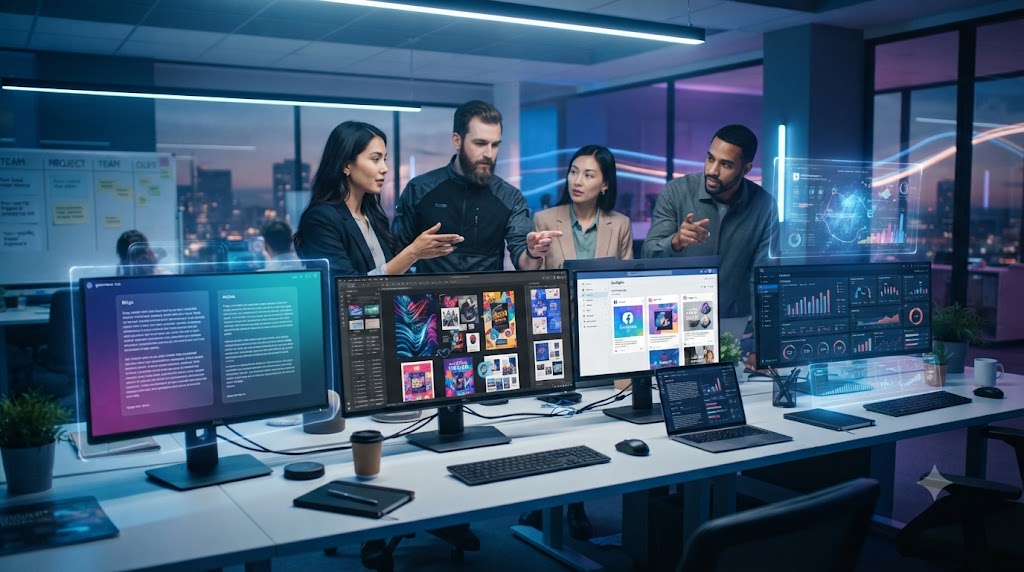
Generative AI can be particularly useful for creating social media graphics, advertising concepts, presentation visuals, website imagery, product mockups, and creative mood boards. It can also help teams explore different visual styles before committing significant resources to a final design.
AI does not necessarily eliminate the role of designers. Instead, it can shift their focus toward creative direction, visual storytelling, brand consistency, composition, and refinement.
Generative AI Is Reshaping Digital Marketing
Marketing teams are increasingly using generative AI to support campaign planning and content production. AI can help marketers create multiple versions of advertisements, email campaigns, product descriptions, social posts, and landing-page copy.
One major advantage is scalability. A marketing team can quickly create variations for different audiences, platforms, languages, and stages of the customer journey.
For example, an online retailer could create different product descriptions for search engines, social media, email newsletters, and mobile applications. AI can assist with adapting the same core message to each format while marketers maintain control over the overall strategy.
Generative AI can also support brainstorming by suggesting campaign concepts, content themes, audience questions, and creative approaches. This gives marketing professionals more opportunities to test ideas and refine campaigns.
Personalization at a Larger Scale
Personalization has become increasingly important in digital marketing, and generative AI can make customized communication easier to produce.
Instead of sending identical messages to every customer, businesses can create content adapted to different interests, behaviors, demographics, or customer journeys. AI can assist in generating personalized recommendations, messages, email variations, and promotional content.
This approach can make digital experiences feel more relevant. However, businesses must handle customer information responsibly and ensure that personalization does not become intrusive or misleading.
Faster Content Production and Lower Repetitive Work
One of the biggest advantages of generative AI is speed. Tasks that previously required hours of manual work can sometimes be completed much faster with AI assistance.
A content team, for example, can use AI to develop an initial article structure, generate headline ideas, create social media variations, and prepare metadata. Designers can use AI to explore concepts before producing polished visuals.
This does not automatically mean that organizations should produce more content simply because production has become easier. The abundance of AI-generated material makes quality, originality, and usefulness even more important.
Changing the Role of Creative Professionals
Generative AI is not only changing creative outputs; it is also changing creative jobs.
Writers may increasingly spend more time researching, editing, fact-checking, developing distinctive perspectives, and directing AI-assisted workflows. Designers may focus more heavily on creative strategy and brand identity. Marketers can dedicate more time to campaign planning, customer understanding, analytics, and experimentation.
New skills are also becoming valuable. Prompt development, AI workflow design, content verification, data literacy, and AI-assisted editing are becoming useful capabilities for many creative professionals.
The future of creative work may therefore be less about choosing between humans and AI and more about determining how humans and AI can work effectively together.
Challenges and Risks of Generative AI
Despite its potential, generative AI introduces several challenges.
Accuracy is one of the biggest concerns. AI systems can generate information that sounds convincing but is incorrect. For this reason, important factual claims should be reviewed against reliable sources.
Copyright and ownership are also significant issues. Businesses and creators need to understand the rules surrounding AI-generated content, training data, licensing, and the use of third-party material.
Another concern is originality. If thousands of organizations rely on similar AI systems and prompts, content can become increasingly predictable. Human creativity and distinctive brand perspectives can help prevent this problem.
There are also concerns surrounding privacy, misinformation, deepfakes, bias, and inappropriate automated content. Responsible use requires organizations to establish clear policies and review processes.
The Importance of Human Creativity
Generative AI can produce content, but creativity involves more than producing words or images. Effective communication requires understanding people, culture, emotions, context, and purpose.
Human creators bring personal experiences, judgment, taste, empathy, and strategic thinking to the creative process. These qualities can help transform AI-generated material into content that feels authentic and meaningful.
The strongest workflows are likely to treat AI as a creative collaborator rather than an unquestioned replacement for human expertise.
What the Future Could Look Like
As generative AI continues to develop, creative workflows are likely to become increasingly integrated with intelligent tools. Content platforms may automatically generate multiple formats from a single piece of source material. Marketing systems could help create personalized campaigns at scale. Designers may work with AI assistants that understand brand guidelines and visual requirements.
At the same time, audiences may become more interested in authenticity and human-created experiences as AI-generated content becomes more common.
Businesses that succeed with generative AI will likely be those that combine technological efficiency with strong creative standards, responsible governance, human oversight, and a clear understanding of their audience.
Conclusion
Generative AI is transforming content creation, design, and marketing by making it easier to generate ideas, produce content, explore visual concepts, and personalize communication. Its biggest impact may not be the replacement of creative professionals but the transformation of how they work.
AI can handle many repetitive and time-consuming tasks, allowing humans to focus more on strategy, originality, storytelling, and decision-making. At the same time, organizations must address accuracy, copyright, privacy, bias, and authenticity.
The future of creative work will increasingly involve collaboration between human imagination and machine-generated capabilities. Businesses and creators that learn to use these technologies responsibly can build faster, more flexible, and more innovative creative workflows.