Category: Robotics · Embodied AI · Automation


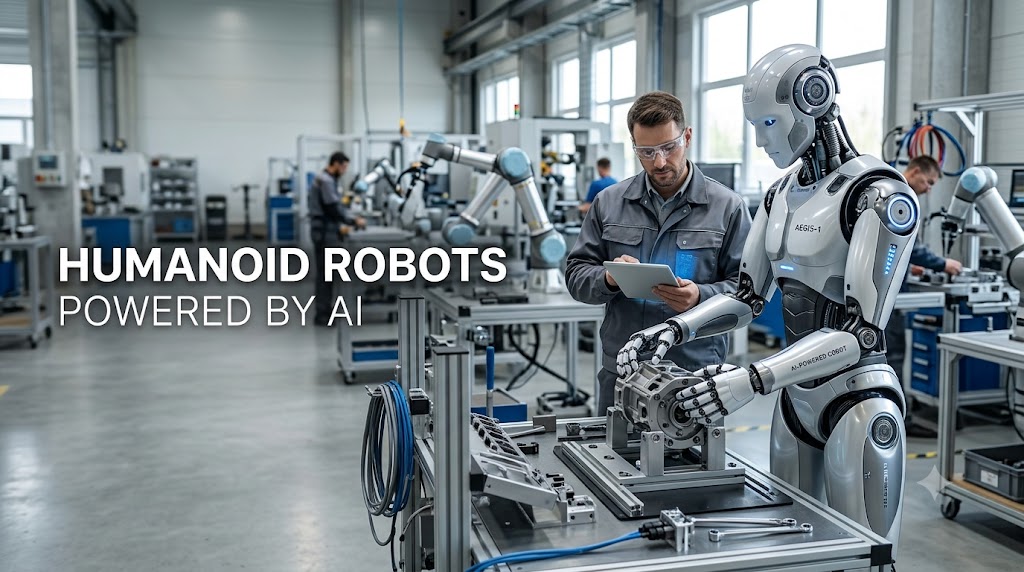
Humanoid robots powered by artificial intelligence are moving from research laboratories into real-world industrial environments. Designed with human-like bodies, hands, arms, and legs, these machines aim to perform tasks in places built for people, from manufacturing plants and warehouses to commercial facilities and eventually homes.
The central question is no longer simply whether a robot can walk, grasp an object, or respond to a voice command. It is whether a robot can perform useful work safely, reliably, and affordably over an entire working day.
Advances in embodied AI, computer vision, machine learning, tactile sensing, and robotic manipulation are bringing this possibility closer. However, general-purpose humanoid robots still face substantial technical and economic challenges.
This research article explores the technology, emerging applications, scientific progress, limitations, and future prospects of AI-powered humanoid robots.
What Are AI-Powered Humanoid Robots?

A humanoid robot is a machine designed with a body structure that resembles the human form. It may have a head or sensor unit, a torso, two arms, hands, and two legs. Some models use wheels or simplified hands rather than reproducing every human feature.
What distinguishes the latest generation is the integration of artificial intelligence with physical movement.
Traditional industrial robots typically repeat carefully programmed actions in controlled environments. AI-powered humanoids aim to interpret their surroundings, understand instructions, choose actions, and adjust their movements when conditions change.
For example, a conventional robotic arm might be programmed to move a particular component between two fixed points. An AI-powered humanoid could potentially identify different components, select the appropriate object, carry it to another workstation, and respond when an item is missing or misplaced.
However, these capabilities vary substantially by robot and task. A successful demonstration does not automatically prove that a machine can complete the same work reliably in an unfamiliar factory.
The Stanford Emerging Technology Review highlights this important distinction: the human-like form offers compatibility with human environments, but the robot still needs better dexterity, reliable control, sufficient energy, and safe interaction to become broadly useful.
How Does Embodied AI Work?

Embodied AI refers to artificial intelligence that perceives and acts through a physical body. Rather than only generating text or analyzing images, the system must convert information into movements that affect the real world.
Several technologies work together to make this possible.
Computer vision and environmental perception
Cameras, depth sensors, and other sensing systems help a robot recognize objects, estimate distances, detect obstacles, and understand the layout of its environment.
A warehouse robot, for instance, must distinguish a box from a shelf, determine whether the box is within reach, and identify a safe path to the destination.
Visual recognition alone is insufficient. The robot also needs to estimate how objects will respond when touched, lifted, pushed, or rotated.
Vision-language-action models
Vision-language-action (VLA) models connect visual observations and language instructions with physical actions. A user might instruct a robot to pick up a container and place it on a designated table.
The model must interpret the instruction, identify the container, determine the relevant movements, and coordinate the robot’s body.
This technology offers a path toward more flexible control, but performance depends on training data, task complexity, sensors, and the robot’s physical capabilities.
Reinforcement learning and simulation
Reinforcement learning allows robotic systems to improve behavior through feedback about their actions. Simulation makes it possible to train movement, balance, and object manipulation in virtual environments before testing on physical machines.
Researchers at Carnegie Mellon University have investigated scalable simulation-to-reality learning for humanoid navigation, grasping, transporting objects, and opening doors. Their work illustrates how simulation, perception, and real-world testing can contribute to more general-purpose skills.
Nevertheless, simulated success does not guarantee real-world success. Friction, lighting, sensor noise, unexpected contact, and hardware wear can all affect performance.
Tactile sensing and motion control
Robots need more than cameras to manipulate objects reliably. Force and tactile sensors can help determine whether an object has been grasped securely, whether excessive pressure is being applied, and whether contact is occurring as expected.
Motion controllers then coordinate motors and joints to maintain balance, adjust grip, and complete the movement.
The key challenge is integrating all these technologies into a system that responds quickly and safely while operating continuously.
Are General-Purpose Humanoid Robots Becoming Practical?
The evidence suggests that humanoid robots are becoming more practical for selected industrial tasks, but truly general-purpose autonomy remains an unfinished goal.
The distinction between progress and widespread readiness is essential.

Material movement and logistics
More mature applications
Transporting containers, moving materials, and handling repetitive logistics tasks are promising starting points because workflows can often be standardized.

Factory assistance
Early deployment and pilots
Robots are being tested for machine tending, component handling, and production support. Reliability, speed, and recovery from mistakes remain important tests.

General household assistance
Major challenges remain
Homes contain clutter, fragile objects, pets, children, stairs, and unpredictable situations. Safe, independent performance across a wide range of chores is considerably harder.
The AI Index Report 2026 identifies industrial pilots and manufacturing ambitions as major signals of progress, rather than evidence of widespread humanoid deployment. It also describes a BMW factory trial in which a humanoid robot accumulated more than 1,250 operating hours and handled over 90,000 parts. These figures demonstrate meaningful industrial experimentation, but they do not establish that all humanoid robots are ready for general production work.
A useful way to judge readiness is to ask four questions:
- Can the robot complete the task consistently, rather than just occasionally?
- Can it recover from unexpected situations without constant human intervention?
- Can it operate safely for long periods?
- Does it deliver enough value to justify its purchase, energy, maintenance, and supervision costs?
Until these questions can be answered with measured results, general-purpose capability should be treated as a developing possibility rather than an established fact.
Real-World Applications of Humanoid Robots


Manufacturing and industrial automation
Factories are among the most promising environments for humanoid robots because many industrial facilities already contain workstations, shelves, tools, and equipment designed for people.
Humanoids could potentially move components, load machines, transfer materials, perform inspections, and support repetitive production tasks. A robot with sufficient mobility could also move between workstations rather than being permanently attached to one location.
For example, Boston Dynamics introduced a production-oriented electric version of its Atlas humanoid in January 2026. The company announced planned deployments at Hyundai and Google DeepMind during 2026, targeting industrial tasks such as material handling and order fulfilment. These announcements demonstrate commercial intent, although deployment plans should not be confused with independently verified productivity at scale.
Warehousing and supply chains
Warehouses require goods to be moved, sorted, loaded, and transferred between locations. Although conventional automated systems already perform many of these tasks, humanoids may help with activities that involve varied equipment or workstations designed for human operators.
A humanoid might collect a container from a shelf, carry it to a packing station, and place it in a designated area. AI could help the robot adapt when object positions change.
However, fixed conveyor systems, automated guided vehicles, and specialized picking robots may remain better choices for many repetitive operations. Humanoids become attractive when their flexibility offsets their additional complexity and cost.
Healthcare and eldercare
Healthcare is an important potential application, especially as many countries face pressure on care services.
In the future, humanoid robots could assist with carrying supplies, retrieving equipment, delivering non-sensitive items, or helping staff with routine logistics. With suitable safeguards, they might also provide reminders and simple forms of assistance to older adults.
But physical care involves far more than moving objects. Helping someone stand, responding to a fall, or supporting a patient with limited mobility requires exceptional reliability, sensitivity to human needs, and strong safety measures.
Humanoid robots should therefore be viewed as potential assistants rather than replacements for nurses, caregivers, or other healthcare professionals. Clinical decisions and sensitive care activities require appropriate human oversight.
Education and research laboratories
Universities and research institutions can use humanoid robots to investigate embodied AI, robot learning, human-machine interaction, and autonomous decision-making.
Students may study how robots interpret instructions, balance while carrying objects, or transfer a skill learned in simulation into a physical environment. Research laboratories can also collect data to improve robotic manipulation and control.
In education, robots could eventually support practical demonstrations in engineering, computer science, and automation. Their value will depend on accessibility, maintenance requirements, educational design, and whether they provide learning benefits beyond less expensive alternatives.
Hazardous and physically demanding work
Humanoid robots may also help reduce human exposure to dangerous conditions, including industrial inspection areas, heavy-material handling zones, and certain emergency environments.
A robot capable of operating existing tools and navigating human-built infrastructure could potentially undertake tasks that would otherwise place workers at risk.
Nevertheless, a humanoid is not automatically the best machine for hazardous work. Wheeled robots, tracked machines, drones, and remotely operated systems may be more stable, energy-efficient, or reliable for specific environments.
The best choice depends on the hazard, the task, the required autonomy, and the consequences of failure.
Leading Humanoid Robotics Developments
Several companies and research organizations illustrate the different approaches being pursued in humanoid robotics.

Atlas — Boston Dynamics
Designed for industrial applications, including material handling and manufacturing support. Its announced 2026 deployment program reflects an effort to move from advanced robotics research toward product-level use.
Evidence: company product announcement.

Figure — Industrial humanoids
Figure’s work in automotive manufacturing has attracted attention because it tests whether humanoids can perform real production tasks rather than merely demonstrate movement in a laboratory.
The Stanford AI Index 2026 documents a BMW factory trial involving more than 1,250 runtime hours and over 90,000 parts handled. Such results are useful evidence of progress in a specific environment, not proof of unrestricted autonomy.

Digit — Agility Robotics
Digit is designed for logistics and material-handling environments. Its development illustrates how a bipedal robot can be optimized for moving objects and working in spaces built for people without attempting to reproduce every human capability.
The wider lesson is that a practical robot does not necessarily need a human-like face or fully dexterous hands to provide value.

Unitree Robotics — Research and commercial platforms
Unitree’s humanoid platforms are part of a broader trend toward expanding robot availability and reducing hardware costs. Greater affordability can help researchers and developers experiment with embodied AI.
Lower purchase prices alone, however, do not establish that a robot is economical to operate in a production environment.
These examples reflect different development strategies. Some companies prioritize industrial reliability, while others emphasize affordability, research access, mobility, or broader AI capabilities.
The Biggest Challenges Facing Humanoid Robots

Reliability and task completion
A humanoid may perform a task successfully in a demonstration but fail when an object is misplaced, lighting changes, or an unfamiliar obstacle appears.
In commercial settings, occasional success is not enough. A robot needs consistently high task-completion rates, predictable recovery from errors, and the ability to operate for extended periods.
A system that requires an engineer to intervene after every few tasks may be unsuitable for an environment that needs continuous productivity.
Dexterity and physical reasoning
Human hands can manipulate objects of many sizes, textures, and shapes. Robotic hands must achieve similar flexibility using motors, joints, sensors, and control algorithms.
Tasks such as handling flexible cables, folding clothing, opening unfamiliar packaging, or picking up a delicate object require precise coordination and sensitivity to contact.
Robots also need to understand physical consequences. Pulling a stuck drawer, carrying an unstable object, or moving around a crowded workspace requires more than recognizing the objects involved.
Battery life and operating time
Humanoid robots consume energy to power motors, sensors, processors, and cooling systems. Walking and maintaining balance can be particularly demanding.
An industrial buyer must consider more than the length of a demonstration. The robot needs enough operating time to justify its role, with practical arrangements for charging, battery replacement, and maintenance.
A 2025 McKinsey analysis identified sustained uptime, safety, dexterity, and cost reduction as important barriers to scaling humanoid deployment.
Safety around people
A humanoid is a moving physical machine that may lift heavy objects, travel through shared spaces, or lose balance.
Potential hazards include collisions, crushing injuries, falling objects, unexpected movements, software failures, and cybersecurity vulnerabilities.
Practical deployment requires multiple layers of protection, including physical safeguards, emergency stops, collision detection, controlled movement, supervision, and rigorous testing.
AI models must also be constrained so that a misunderstood instruction cannot lead to dangerous action. Safety cannot depend solely on the robot correctly interpreting every situation.
Cost and economic value
The purchase price is only one part of the financial calculation. Organizations must also budget for maintenance, replacement parts, software, integration, energy, training, downtime, and human supervision.
The relevant question is not whether a humanoid is cheaper than a human worker in isolation. It is whether the entire robotic system performs a defined job at an acceptable cost and quality level.
A specialized robot may still outperform a humanoid when the task is repetitive and the environment can be designed around the machine.
How Should Researchers Measure Progress?
One of the biggest problems in humanoid robotics is that spectacular demonstrations can create unrealistic expectations.
A robot completing a single complex task on camera does not reveal how many attempts were required, how frequently it failed, how much human assistance it received, or how long it can operate independently.
Research evaluations should report practical measures such as:
- Task success rate: How often does the robot finish the task correctly?
- Intervention frequency: How often must a human take control?
- Cycle time: How long does each task take compared with an appropriate alternative?
- Continuous uptime: How long can the robot operate before charging, repairs, or intervention?
- Transferability: Can it handle unfamiliar objects, locations, and task variations?
- Safety performance: How often do near misses, collisions, or hazardous failures occur?
- Total operating cost: How much does it cost to complete each successful task?
These measures allow researchers and businesses to distinguish a promising prototype from a useful operational system.
A 2026 assessment by Samaritan Research similarly emphasizes reliability, speed, cost, and the ability to transfer skills to new environments. Its analysis warns that capabilities demonstrated in specific settings should not automatically be assumed to generalize.
Economic and Social Impact
Humanoid robots could reshape the way organizations distribute physical work. Their potential impact extends beyond automation itself to the design of workplaces, the demand for technical skills, and the relationship between workers and machines.
Productivity and labor shortages
Businesses may use humanoids to undertake repetitive, physically demanding, or difficult-to-staff tasks. If they become reliable and affordable, they could help organizations maintain production and reduce exposure to some workplace hazards.
However, these benefits are not guaranteed. The business case depends on the task, the operating environment, and the performance of existing automation.
Employment and workforce transformation
Some jobs may be automated partially or completely, while others may change to include robot supervision, maintenance, programming, safety evaluation, and workflow management.
Workers will need opportunities to develop relevant technical skills. Employers and policymakers should plan for training and transitions rather than assuming that productivity gains will benefit every worker equally.
The long-term impact will depend on how organizations introduce the technology and how the economic benefits are distributed.
Accessibility and daily living
Assistive robots could eventually help some people with mobility limitations complete everyday activities. They might retrieve objects, carry groceries, or assist with routine household tasks.
Yet household assistance presents a difficult combination of affordability, reliability, privacy, and safety requirements. A robot that works well in a factory may struggle in a cluttered home.
Accessible design should therefore focus on real user needs rather than the novelty of a human-like machine.
What Does the Research Say About the Future?
Research points toward gradual, application-specific progress rather than an immediate transition to fully autonomous robots capable of performing every human task.
The Capgemini Research Institute published a 2026 report on physical AI based on a global survey of 1,678 senior executives across 15 industries. The report describes growing organizational interest in humanoids, while also identifying the need to address operational, technical, and governance challenges before scaling adoption.
Three developments will be especially important.
First, more capable AI models. Robots need models that can connect perception, language, planning, and physical action. Better models could improve flexibility, but only if their decisions translate into dependable real-world behavior.
Second, better learning from experience. Simulation, teleoperation, demonstrations, and real-world operational data can help robots acquire skills. Researchers must still determine how to make those skills transfer reliably to unfamiliar tasks and environments.
Third, improved hardware and deployment systems. More durable actuators, dexterous hands, better batteries, effective safety systems, and simpler maintenance could make humanoids more practical.
Progress in one area will not automatically solve the others. A robot with excellent AI but unreliable hardware is not a dependable worker. Similarly, a strong mechanical platform may have limited value if it cannot adapt to changes in its environment.
Research Limitations and Open Questions
Although the field is developing quickly, several uncertainties deserve attention.
Public demonstrations may not provide enough information to assess long-term reliability. Company announcements often describe planned capabilities or deployments rather than independently audited operational outcomes.
There is also no single benchmark that captures every aspect of general-purpose intelligence in a physical robot. Success in walking, grasping, or language instruction does not necessarily indicate competence across all three.
Future studies should compare humanoids with conventional automation, measure long-term performance, document human intervention, and test whether skills transfer across environments. Independent evaluation will be essential for distinguishing genuine progress from marketing claims.
Researchers should also investigate privacy, cybersecurity, responsibility for accidents, and the effects of automation on workers and communities.
Conclusion: Are General-Purpose Humanoid Robots Becoming Practical?
AI-powered humanoid robots are becoming increasingly capable, and industrial trials show that they are moving beyond research demonstrations. Embodied AI, improved perception, robotic manipulation, and simulation-based learning are expanding what these machines can attempt.
However, becoming practical for a defined task is not the same as becoming genuinely general-purpose.
The strongest near-term opportunities are likely to involve carefully selected industrial and logistics activities where tasks can be measured, environments can be controlled, and safety procedures can be established. Broader household, healthcare, and public-facing applications will require more dependable autonomy and stronger safeguards.
The most important measure of progress will not be how human-like a robot appears or how impressive its movements look. It will be whether the machine can complete useful work repeatedly, safely, and economically, with minimal human intervention.
The future of humanoid robotics is promising, but its success will depend on turning advances in artificial intelligence into dependable physical performance.