The Rise of Multimodal AI Combining Text, Images, Audio, Video, and Real-World Understanding


Introduction: AI Is Learning to Understand the World Like Humans 🧠✨
For decades, computers were limited to processing structured information such as numbers, codes, and simple commands. The arrival of modern artificial intelligence changed this by allowing machines to understand and generate human language.
Large language models introduced a new era where AI could write articles, answer questions, summarize information, and assist with complex tasks. However, text-based AI represents only one part of human intelligence.
Humans do not experience the world through words alone. We see images, hear sounds, understand emotions, observe movement, and interact with physical environments.
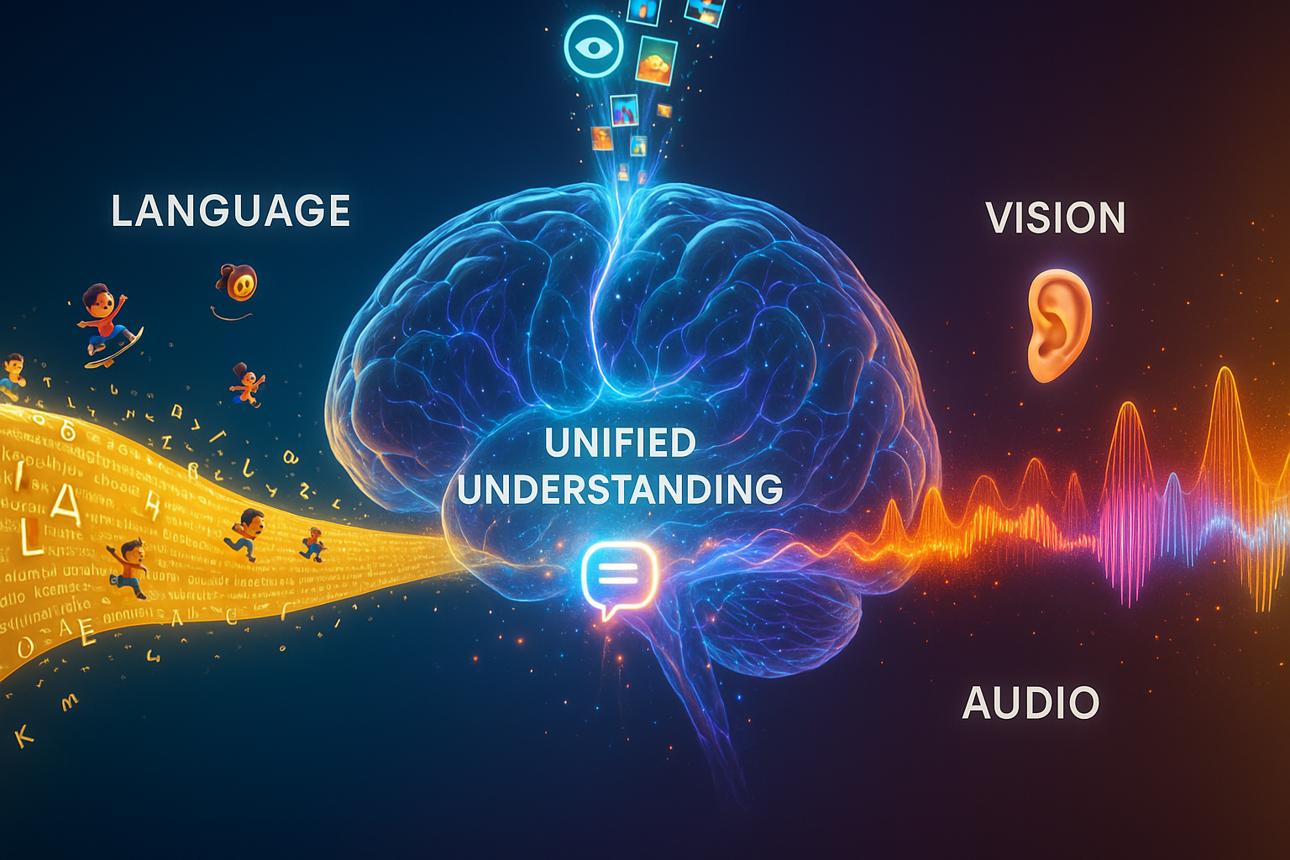
The next generation of artificial intelligence is moving beyond text. It is becoming multimodal AI—a technology capable of understanding and combining multiple forms of information, including:
- Text
- Images
- Audio
- Video
- Voice
- Real-world data
Instead of simply reading information, future AI systems will be able to observe, listen, reason, and create.
This transformation could redefine how humans interact with technology.
1. What Is Multimodal AI? 🤖
Multimodal AI refers to artificial intelligence systems that can process and understand different types of data simultaneously.
Traditional AI systems often specialized in one area:
- Text AI understood language
- Computer vision AI analyzed images
- Speech AI recognized voices
Multimodal AI combines these abilities into one intelligent system.
For example, a multimodal AI assistant could:
- Look at a photo
- Understand what is happening
- Listen to a spoken question
- Analyze related information
- Provide a detailed answer
This is closer to how humans naturally understand the world.
When someone sees a broken machine, they do not only read a manual. They observe the object, hear unusual sounds, understand the situation, and use previous knowledge to solve the problem.
Multimodal AI aims to achieve similar capabilities.
2. From Text-Based Chatbots to Intelligent AI Partners 💬➡️🌐


The first generation of popular AI assistants focused mainly on text conversations.
Users typed questions, and AI responded with written answers.
This was revolutionary, but limited.
The future AI assistant will not only read words—it will understand context.
Imagine an AI assistant that can:
- Watch a video you upload
- Explain what is happening
- Analyze a document
- Listen to your voice instructions
- Create a presentation
- Generate images or videos
Instead of interacting with AI through a keyboard, people will communicate naturally through conversation, vision, and actions.
The relationship between humans and AI will become more like collaboration rather than simple question-and-answer interactions.
3. AI That Can See: The Rise of Computer Vision 👁️
Computer vision allows AI systems to interpret visual information.
Today, AI can analyze:
- Photos
- Medical scans
- Security footage
- Satellite images
- Industrial equipment
Future multimodal AI will make vision capabilities much more advanced.
Understanding Images Like Humans
A future AI system will not simply identify objects.
It may understand:
- Relationships between objects
- Human activities
- Environmental conditions
- Emotional expressions
- Complex situations
For example, instead of saying:
“There is a person holding a tool.”
An advanced AI may understand:
“A technician appears to be repairing a machine and may need a replacement component based on visible damage.”
This deeper understanding will create new possibilities in many industries.
4. AI That Can Hear: The Future of Voice Intelligence 🎧


Voice is one of the most natural ways humans communicate.
Modern AI is becoming increasingly skilled at understanding speech, tone, and context.
Future voice-based AI will be able to recognize:
- Different accents
- Emotional changes
- Speaking patterns
- Background sounds
- Conversation context
This could transform:
Customer Service
AI agents could handle complex conversations while understanding customer emotions.
Healthcare
AI systems could analyze speech patterns to assist medical professionals.
Education
AI tutors could provide natural conversations with students.
Accessibility
People with disabilities could interact with technology more easily.
Voice AI will make digital systems feel more human and accessible.
5. AI That Understands Video: Machines Learning Through Time 🎥
Video understanding represents one of the biggest challenges and opportunities in AI.
Images show a single moment. Videos show events unfolding over time.
Understanding video requires AI to analyze:
- Movement
- Actions
- Cause and effect
- Human behavior
- Environmental changes
Future video-capable AI could assist in:
Security
AI could detect unusual activities in real time.
Education
AI tutors could analyze demonstrations and explain complex processes.
Entertainment
AI could help create movies, animations, and interactive experiences.
Robotics
Robots could learn from observing humans perform tasks.
Video understanding brings AI closer to real-world intelligence.
6. AI That Can Create: The New Era of Generative Intelligence 🎨


Multimodal AI is not only about understanding information—it is also about creation.
Modern AI systems can already generate:
- Images
- Text
- Music
- Videos
- Designs
- Software code
The future will combine understanding and creativity.
An AI system could receive a simple idea:
“Create a promotional video for a sustainable energy company.”
It could then:
- Write the script
- Generate visuals
- Create narration
- Produce background music
- Edit the final video
This could dramatically change creative industries.
AI will become a powerful creative partner for designers, writers, filmmakers, and entrepreneurs.
7. Multimodal AI in Healthcare 🏥
Healthcare may become one of the biggest beneficiaries of multimodal AI.
Medical professionals work with many types of information:
- Patient conversations
- Medical images
- Laboratory results
- Health records
- Research papers
Multimodal AI can combine these sources to provide deeper insights.
Examples include:
Faster Diagnosis
AI can analyze images alongside patient history and symptoms.
Personalized Treatment
AI can recommend approaches based on individual health information.
Medical Research
AI can analyze millions of scientific documents and clinical data.
The goal is not replacing doctors but giving them advanced tools for better decisions.
8. Multimodal AI in Education 📚
Education has traditionally followed a one-size-fits-all approach.
Multimodal AI could create personalized learning experiences.
An AI tutor could:
- Explain concepts through text
- Create diagrams
- Generate videos
- Answer spoken questions
- Adjust teaching methods based on student understanding
A student struggling with mathematics could receive:
- A written explanation
- A visual demonstration
- A voice explanation
- Interactive practice problems
Learning could become more personalized than ever before.
9. AI and the Real World: From Digital Intelligence to Physical Intelligence 🌍
The next major step is connecting AI with the physical world.
Multimodal AI will power:
- Robots
- Smart vehicles
- Smart homes
- Industrial machines
- Autonomous systems
A robot equipped with multimodal intelligence could:
- See objects
- Hear instructions
- Understand environments
- Make decisions
- Perform physical tasks
This moves AI from digital spaces into real-world interaction.
10. The Challenges of Multimodal AI ⚠️
Despite its potential, multimodal AI creates important challenges.
Privacy Concerns
AI systems capable of seeing and hearing may process highly personal information.
Protecting user data will become increasingly important.
Accuracy and Reliability
AI may misunderstand images, sounds, or situations.
High-stakes applications require careful testing.
Ethical Use
Powerful AI tools could be misused for:
- Fake content creation
- Digital manipulation
- Privacy violations
Responsible development will determine how beneficial this technology becomes.
The Future: AI That Understands Human Reality 🚀
The next generation of AI will not simply answer questions.
It will understand environments, interpret experiences, and interact naturally.
Imagine an AI assistant that can:
- Watch your work process
- Understand your goals
- Suggest improvements
- Create solutions
- Communicate naturally
This represents a fundamental shift from AI as a tool to AI as an intelligent collaborator.
Conclusion: The Age of Multimodal Intelligence Has Begun 🌟
The future of artificial intelligence is moving beyond text-based conversations.
Multimodal AI represents the next major evolution—machines that can see, hear, think, and create.
By combining language understanding with vision, audio processing, video analysis, and real-world awareness, AI systems are becoming more connected to human experiences.
The future will not be defined only by smarter algorithms. It will be defined by AI systems that understand the world around us and help humans solve problems in new ways.
The era of multimodal intelligence has arrived, and it may become the foundation of the next technological revolution. 🚀