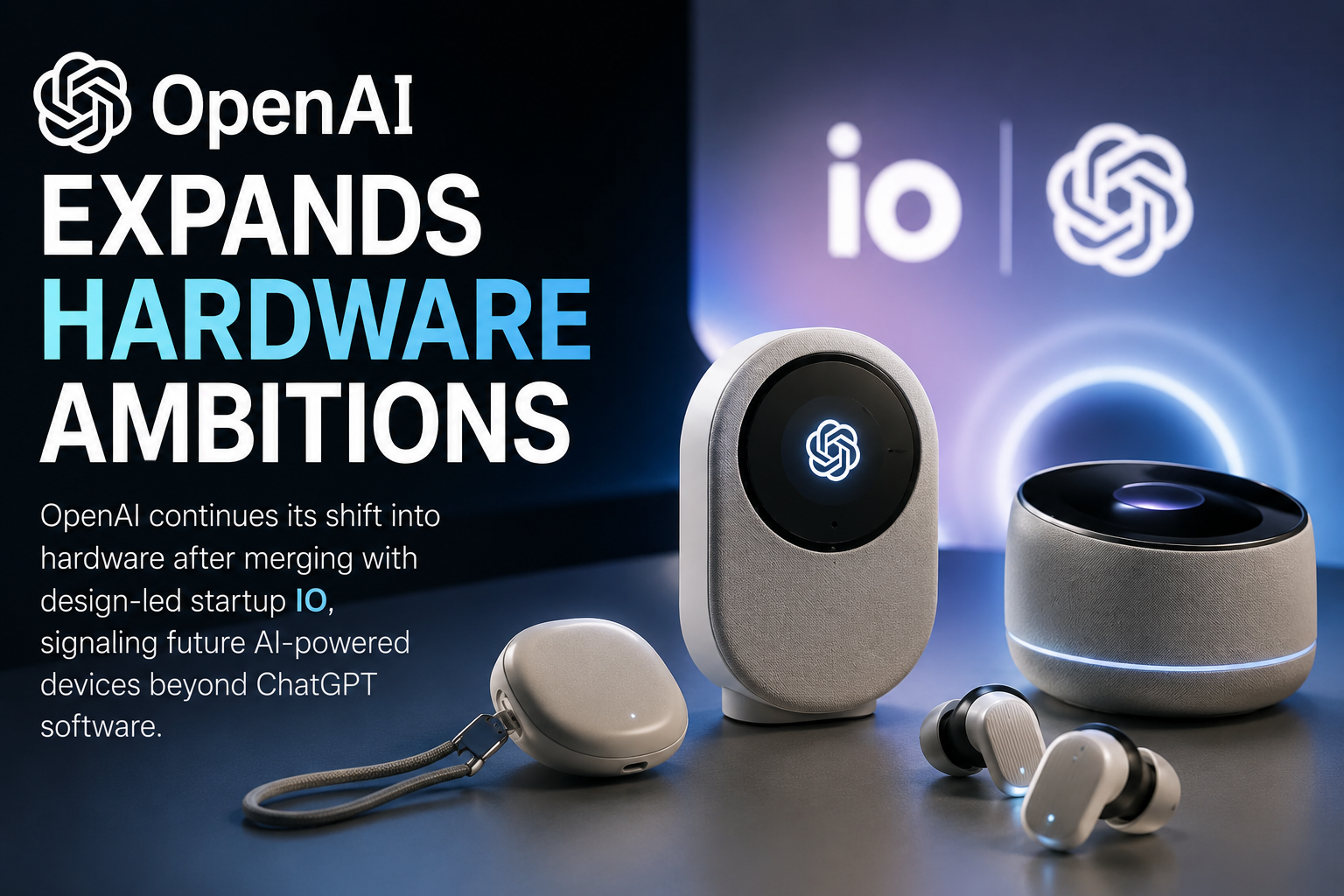
The artificial intelligence landscape is rapidly evolving, and OpenAI is no longer positioning itself as a purely software-driven company. With its continued expansion into hardware and a strategic merge with the design-focused startup IO, OpenAI is signaling a major shift: the future of AI may not live only in chat windows—but in physical devices embedded into everyday life.
This move suggests a broader vision where AI becomes deeply integrated into tools we wear, carry, and interact with naturally—beyond keyboards and screens. Instead of just asking ChatGPT questions, users may soon interact with AI through dedicated devices designed from the ground up for intelligence-first experiences.
A Strategic Shift: Why OpenAI Is Moving Into Hardware


For most of its history, OpenAI has been synonymous with software: large language models, APIs, and conversational agents. But the limits of software-only AI are becoming more obvious.
Even the most advanced models still rely on smartphones, laptops, and operating systems built for a pre-AI world. That creates friction:
- AI is “one app among many”
- User interaction depends on typing or tapping
- Context switching reduces efficiency
- The experience is not always seamless or continuous
Hardware changes that equation.
By designing its own devices—or tightly integrating AI into purpose-built hardware—OpenAI can control the entire user experience: from sensors and microphones to display logic, latency optimization, and real-world context awareness.
The merger with IO, a design-centric startup, reinforces this direction. It suggests that OpenAI is not just experimenting with hardware—it is investing in industrial design, product engineering, and possibly consumer electronics.
The IO Merger: Design Meets Intelligence


While details about IO remain limited, the strategic intent behind the merger is clear: OpenAI wants design DNA embedded into its hardware future.
Historically, AI companies have excelled in algorithms but struggled with consumer product design. Hardware success requires:
- Industrial design expertise
- Supply chain and manufacturing understanding
- Ergonomics and user experience thinking
- Long-term product iteration cycles
By bringing IO into its ecosystem, OpenAI appears to be closing that gap.
This move also mirrors a broader tech trend: AI companies evolving into full-stack product companies rather than backend model providers.
If successful, OpenAI could follow a path similar to companies that transitioned from software platforms into ecosystem-driven hardware ecosystems—where devices become the primary interface for services.
Beyond Smartphones: A New Category of AI Devices


One of the most interesting implications of OpenAI’s hardware push is the potential creation of an entirely new product category.
Instead of competing directly with smartphones, OpenAI may aim to redefine how humans interact with AI in physical space. Possible device directions include:
1. Wearable AI Assistants
Devices like pins, earbuds, or pendants that provide always-on assistance through voice and contextual awareness.
2. Ambient AI Hubs
Home or office devices that act as intelligent environmental controllers—handling scheduling, communication, and automation.
3. Screenless Interaction Devices
Tools that minimize visual dependency and rely on voice, gesture, or spatial computing.
4. AI Companion Devices
Personal assistants designed to maintain continuous context across a user’s day—bridging gaps between apps, devices, and tasks.
These ideas reflect a broader shift: AI becoming less of a tool you open, and more of a presence that is always available.
Why Hardware Matters for AI’s Future


AI models are becoming more powerful, but they are still constrained by how users access them. Hardware plays a key role in solving several problems:
1. Latency Reduction
Dedicated devices can optimize AI inference locally or at the edge, reducing response time significantly.
2. Context Awareness
Hardware equipped with sensors (audio, visual, location) can provide richer contextual input to AI systems.
3. Always-On Intelligence
Unlike apps, hardware devices can remain continuously active, enabling proactive assistance.
4. Privacy Control
On-device processing may allow sensitive data to stay local, improving user trust.
5. New Interaction Models
Hardware enables interaction methods beyond touchscreens—voice, gestures, spatial awareness, and even gaze tracking.
This combination could unlock AI experiences that feel less like querying a tool and more like interacting with an intelligent system embedded in reality.
Competitive Landscape: The Race for AI Hardware


OpenAI is not entering this space alone. The AI hardware race is already heating up.
Several technology leaders are exploring similar directions:
- Consumer tech giants building AI-integrated smartphones and assistants
- Startup ecosystems experimenting with wearable AI companions
- Cloud companies pushing AI-enabled edge devices
- AR/VR companies merging spatial computing with generative AI
However, OpenAI’s advantage lies in its model leadership. It already controls one of the most widely used AI systems globally. Integrating that intelligence directly into hardware could create a tightly optimized ecosystem from chip to interface.
The challenge will be execution. Hardware requires:
- Long development cycles
- Manufacturing partnerships
- Logistics and distribution
- Customer support infrastructure
These are very different from shipping software updates.
The Role of Design: Why IO Matters More Than It Seems


The merger with IO highlights something crucial: AI hardware success is not just about intelligence—it is about experience.
A powerful AI embedded in a poorly designed device will fail. A simple AI in an elegant, intuitive device could redefine an entire category.
Design will influence:
- Whether users trust the device
- How often they use it
- Whether it feels intrusive or helpful
- How seamlessly it integrates into daily life
In this sense, IO may play a role similar to what design firms or product studios have historically done for major consumer electronics breakthroughs: shaping not just how a product looks, but how it behaves in the real world.
Challenges Ahead for OpenAI’s Hardware Vision


Despite the excitement, OpenAI’s hardware ambitions face significant challenges:
Manufacturing Complexity
Building consumer electronics at scale is difficult, expensive, and highly competitive.
Market Expectations
Consumers already expect polished, reliable devices from established hardware brands.
Privacy Concerns
Always-on AI devices raise important questions about surveillance, data storage, and consent.
Battery and Performance Constraints
AI processing requires significant compute power, which must be balanced with portability.
Ecosystem Competition
Existing ecosystems (mobile OS platforms, app stores, smart home systems) are deeply entrenched.
Success will depend not only on innovation, but on execution across engineering, design, and global supply chains.
What This Means for the Future of AI Interaction


If OpenAI succeeds, the way people think about AI could fundamentally change.
Instead of:
“I open an app to use AI”
The interaction could become:
“AI is always available in my environment”
This shift would blur the line between tool and companion. AI would move from being reactive—waiting for prompts—to being proactive—anticipating needs and assisting continuously.
In practical terms, this could transform:
- Productivity workflows
- Education and learning
- Accessibility tools
- Communication across languages
- Smart environments in homes and workplaces
The biggest change is psychological: AI becomes less of a destination and more of an ambient layer of daily life.
Conclusion: A New Chapter for OpenAI
OpenAI’s expansion into hardware marks a pivotal moment in the evolution of artificial intelligence. By merging with IO and signaling ambitions beyond software, the company is positioning itself at the frontier of a new computing paradigm—one where intelligence is not just accessed, but embedded into physical reality.
This is still early. No definitive product has been released, and many questions remain unanswered. But the direction is clear: AI is leaving the screen and entering the world.
If successful, OpenAI may not just change how we use software—it could change what we consider a “computer” in the first place.