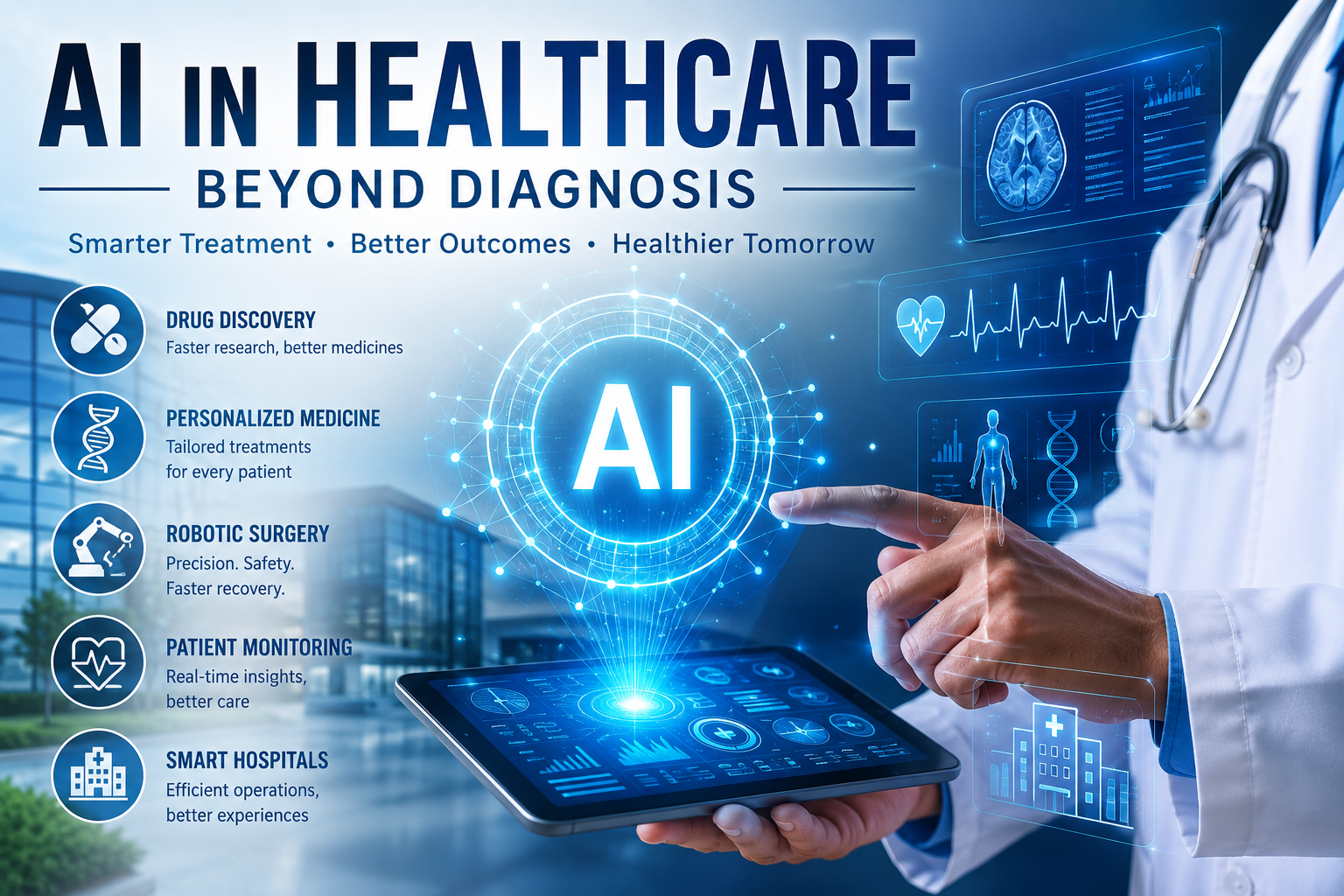
From life-saving drug discovery to intelligent hospitals, AI is transforming healthcare in ways that extend far beyond diagnosing diseases.
🌍 Introduction


Artificial Intelligence (AI) has rapidly evolved from a futuristic concept into one of the most transformative technologies in healthcare. While many people associate AI with detecting diseases through X-rays or MRI scans, today’s AI systems are making a much broader impact. They are accelerating drug discovery, enabling personalized medicine, assisting surgeons in operating rooms, continuously monitoring patients through wearable devices, and helping hospitals run more efficiently.
Healthcare systems worldwide face unprecedented challenges. Growing populations, aging societies, physician shortages, rising healthcare costs, and increasing chronic diseases are placing enormous pressure on hospitals and medical professionals. AI offers powerful solutions that improve patient outcomes while reducing costs and administrative burdens.
Unlike traditional software that follows fixed instructions, AI systems learn from vast amounts of medical data. They recognize patterns, predict outcomes, automate repetitive tasks, and support clinicians in making faster, more informed decisions.
In this comprehensive guide, we’ll explore how AI is transforming healthcare beyond diagnosis, highlighting real-world applications, benefits, challenges, and the exciting future of intelligent medicine.
🤖 What Is AI in Healthcare?
Artificial Intelligence in healthcare refers to computer systems that simulate human intelligence to analyze medical information, recognize complex patterns, and support healthcare professionals.
Several AI technologies work together to power modern healthcare solutions:
- 🧠 Machine Learning
- 📊 Deep Learning
- 💬 Natural Language Processing (NLP)
- 👁️ Computer Vision
- 📈 Predictive Analytics
- ✨ Generative AI
- 🌐 Reinforcement Learning
Together, these technologies improve clinical decision-making, optimize operations, and enhance patient experiences.
💊 1. AI in Drug Discovery


🧬 Why Traditional Drug Development Is Difficult
Developing a new medicine is one of the most expensive scientific processes in the world.
Typically, it requires:
- ⏳ 10–15 years
- 💰 Billions of dollars
- 🔬 Thousands of failed compounds
- 🧪 Multiple clinical trial phases
Only a tiny percentage of drug candidates ultimately receive regulatory approval.
🚀 How AI Speeds Up Drug Discovery
AI can rapidly analyze millions of chemical compounds, predict how they interact with proteins, estimate toxicity, and identify the most promising drug candidates before laboratory testing even begins.
🔍 Molecule Design
Generative AI can create entirely new molecular structures tailored to specific diseases.
Benefits include:
- Faster discovery
- Reduced laboratory experiments
- Lower research costs
- Better success rates
💡 Drug Repurposing
Instead of starting from scratch, AI identifies existing medicines that may treat different diseases.
Examples include:
- Diabetes drugs used for obesity
- Cancer drugs evaluated for autoimmune diseases
- Antiviral drugs assessed during outbreaks
Repurposing saves years of research.
🧪 Clinical Trial Optimization
AI helps researchers:
- Select suitable participants
- Predict trial outcomes
- Reduce patient dropout
- Monitor safety
- Analyze results faster
This shortens development timelines while improving efficiency.
🧬 2. Personalized Medicine
Every patient is biologically unique.
The same treatment may produce different results in different people.
AI enables precision medicine by tailoring healthcare to an individual’s unique characteristics.
📊 Data Sources Used by AI
AI combines information from:
- DNA sequencing
- Genetic mutations
- Electronic health records
- Blood tests
- Lifestyle habits
- Wearable devices
- Family history
- Medical imaging
🎯 Personalized Cancer Treatment
Instead of using identical treatments for all patients, AI helps oncologists determine:
- Which chemotherapy is most effective
- Whether immunotherapy is appropriate
- Genetic mutations driving tumor growth
- Risk of recurrence
Patients receive treatments with higher chances of success and fewer unnecessary side effects.
❤️ Chronic Disease Management
AI personalizes treatment plans for conditions such as:
- Diabetes
- Heart disease
- Kidney disease
- Asthma
- Hypertension
Medication adjustments and preventive recommendations can be made using continuously updated patient data.
🤖 3. AI-Assisted Robotic Surgery


Modern surgical robots do not replace surgeons—they enhance their capabilities.
AI-powered systems assist by providing:
- Better visualization
- Greater precision
- Motion stabilization
- Real-time guidance
🏥 Common Procedures
Robotic surgery is widely used in:
- Urology
- Cardiac surgery
- Gynecology
- Orthopedics
- General surgery
- Colorectal procedures
⭐ Benefits
- 🔹 Smaller incisions
- 🔹 Reduced blood loss
- 🔹 Lower infection risk
- 🔹 Faster recovery
- 🔹 Less postoperative pain
- 🔹 Greater surgical accuracy
Future AI systems may identify tissue types, warn of nearby nerves or blood vessels, and predict complications during surgery.
⌚ 4. AI-Powered Patient Monitoring
Continuous monitoring is transforming patient care.
Smart devices collect health information around the clock, while AI identifies warning signs before serious complications develop.
📱 Common Devices
Examples include:
- Smartwatches
- ECG patches
- Blood glucose monitors
- Blood pressure monitors
- Pulse oximeters
- Sleep trackers
🚨 Early Detection
AI can recognize patterns associated with:
- Irregular heart rhythms
- Heart failure
- Stroke risk
- Falls
- Sleep disorders
- Respiratory diseases
- Sepsis
Healthcare providers can intervene sooner, often preventing emergencies.
🏠 Home Healthcare
Patients recovering at home can remain connected to healthcare teams through AI-powered remote monitoring, reducing unnecessary hospital visits while improving safety.
🏥 5. AI in Hospital Operations


AI also improves the way hospitals operate behind the scenes.
📅 Smart Scheduling
AI optimizes:
- Patient appointments
- Staff shifts
- Operating room availability
- Resource allocation
This reduces waiting times and improves productivity.
🛏️ Bed Management
Hospitals use AI to predict:
- Patient discharge times
- Bed availability
- ICU occupancy
- Emergency department demand
Better forecasting helps hospitals manage patient flow more effectively.
📦 Supply Chain Optimization
AI predicts demand for:
- Medicines
- PPE
- Surgical instruments
- Laboratory supplies
Reducing shortages and waste saves both money and lives.
📄 Administrative Automation
AI automates:
- Clinical documentation
- Medical coding
- Billing
- Insurance claims
- Appointment reminders
- Voice transcription
Doctors spend less time on paperwork and more time caring for patients.
📈 Predictive Healthcare Analytics
Predictive AI analyzes historical and real-time data to forecast future health risks.
Applications include:
- ❤️ Heart attack prediction
- 🧠 Stroke risk assessment
- 🏥 Hospital readmission prediction
- 💊 Medication adherence
- 🦠 Disease outbreak forecasting
- 📉 Population health management
Preventive care becomes more proactive, improving outcomes and reducing costs.
💬 Generative AI as a Clinical Assistant
Generative AI is helping clinicians with everyday tasks.
It can:
- Summarize patient histories
- Draft clinical notes
- Explain medical terms in simple language
- Prepare discharge instructions
- Assist with research
- Answer routine patient questions
This reduces administrative burden while improving communication.
🧪 AI in Medical Research
Researchers use AI to:
- Analyze genomic data
- Discover biomarkers
- Simulate biological processes
- Review scientific literature
- Identify promising treatment pathways
Tasks that once required months can now often be completed in days.
🩺 AI in Medical Imaging
Although this article focuses beyond diagnosis, imaging remains an important area.
AI supports radiologists by:
- Prioritizing urgent cases
- Highlighting abnormalities
- Measuring tumors
- Comparing historical scans
- Reducing reporting time
Human specialists still make the final clinical decisions.
🌍 AI and Public Health
AI also contributes at the population level.
Examples include:
- Predicting infectious disease spread
- Monitoring environmental health risks
- Supporting vaccination campaigns
- Detecting health trends
- Allocating emergency resources
These capabilities help governments and healthcare organizations respond more effectively.
⚠️ Challenges and Ethical Considerations
AI brings tremendous opportunities, but responsible implementation is essential.
Key challenges include:
- 🔒 Protecting patient privacy
- 🛡️ Ensuring cybersecurity
- ⚖️ Reducing algorithmic bias
- 📋 Meeting regulatory standards
- 👨⚕️ Maintaining human oversight
- 🔍 Improving transparency and explainability
AI should complement—not replace—the expertise, empathy, and judgment of healthcare professionals.
🚀 The Future of AI in Healthcare
The next decade is expected to bring:
- 🤖 More capable robotic surgery
- 🧬 AI-designed medicines
- 🩺 Digital twins for personalized treatment simulation
- 🏥 Fully integrated smart hospitals
- 🌐 Expanded telemedicine
- ⌚ Continuous health monitoring
- 🧠 Multimodal AI combining imaging, laboratory results, clinical notes, and wearable data
- 🌍 Improved global health surveillance
As AI systems become more sophisticated, collaboration between clinicians, engineers, researchers, and policymakers will be critical to ensure these technologies are safe, equitable, and beneficial.
💡 Key Benefits of AI Beyond Diagnosis
| 🌟 Area | ✅ Benefits |
|---|---|
| Drug Discovery | Faster research, lower costs, improved candidate selection |
| Personalized Medicine | Tailored treatments, fewer side effects |
| Robotic Surgery | Greater precision, quicker recovery |
| Patient Monitoring | Early detection, continuous care |
| Hospital Operations | Better efficiency, reduced administrative workload |
| Predictive Analytics | Earlier interventions, improved preventive care |
| Medical Research | Faster discoveries, deeper insights |
🎯 Conclusion
Artificial Intelligence is reshaping healthcare far beyond disease diagnosis. From accelerating the discovery of new medicines and enabling personalized treatments to assisting surgeons, monitoring patients remotely, and streamlining hospital operations, AI is becoming an indispensable partner in modern medicine.
The greatest promise of AI lies not in replacing healthcare professionals but in empowering them. By handling repetitive tasks, uncovering hidden patterns in data, and supporting faster decision-making, AI allows clinicians to focus on what matters most—providing compassionate, high-quality patient care.
As technology advances, responsible development, strong privacy protections, rigorous validation, and human oversight will remain essential. When implemented thoughtfully, AI has the potential to create a healthcare system that is more accessible, efficient, personalized, and proactive than ever before.
The future of healthcare is not just digital—it is intelligent, collaborative, and centered on improving lives. 🌍❤️